Jackery Explorer 1000 explained: v2 specs, price, charging
Disclosure: Some links in this guide are affiliate links. If you buy through them we may earn a commission, at no extra cost to you. We only link to products the guide is about. How we make money.
On this page
The short answer
The Jackery Explorer 1000 is a portable power station of about 1 kWh. The current model is the Explorer 1000 v2. Jackery says it "Delivers 1024Wh Capacity and 1500W Output". 1 On 24 November 2026, Jackery's US store showed US$559.00 on its own and US$879.00 with a SolarSaga 200W panel, both marked "Sold Out" that day. 1 The original Explorer 1000 listed 1002Wh and "Lithium-ion Battery (NCM)" cells. 2
What the Jackery Explorer 1000 is
The Explorer 1000 is a portable power station from Jackery. 1 A power station is a big rechargeable battery with outlets on the front. You charge it, then plug lamps, phones or small appliances straight into it. There's no engine and no fuel. If the idea is new, our power station basics page covers how they work.
Two versions share the name. The original Explorer 1000 is the older one. Jackery's information page lists its "Battery Capacity 1002Wh" and "500 cycles" of rated life. 2 The Explorer 1000 v2 is the one Jackery's US store lists now. 1
So check the label before you compare figures. Most numbers changed between the two.
We haven't used either one. Every figure here comes from Jackery's own pages, read on 24 November 2026. 1 2
Explorer 1000 v2 specs from Jackery's page
Jackery's headline for the v2 is short. It "Delivers 1024Wh Capacity and 1500W Output". 1 Wh, or watt-hours, is how much energy the battery holds. W, or watts, is how much it can supply at the same moment.
The US spec table gives a slightly different capacity: "30.4Ah/35.2V DC (1070 Wh)". 1 We use the lower 1024Wh figure in our sums below. Here's the rest of the spec list:
- AC output: "(3x) 120V ~ 60Hz", with "1500W Rated, 3000W Surge peak". 1 Surge is a short burst for starting motors. - USB-C: one port at "(1x) 100W Max" and one at "(1x) 30W Max". 1 - Battery: "LiFePO4" cells rated for "4000 cycles to 70%+ capacity". 1 - Weight: "Around 23.8 lbs (10.8 kg)". 1 - Size: "12.87 × 8.82 × 9.72 in". 1
LiFePO4 is lithium iron phosphate. Our page on lithium iron phosphate cells explains the chemistry in plain English. To set these numbers against another 1 kWh station, see the EcoFlow Delta 2 and Delta 3 specs.
Price on 24 November 2026
Jackery's US store showed three bundles that day. Each was marked "Sold Out", with a "Notify Me When Available for Pre-order" button. 1
- Explorer 1000 v2 on its own: US$559.00 on 24 November 2026. 1 - Explorer 1000 v2 + SolarSaga 200W: US$879.00 on 24 November 2026. 1 - Two Explorer 1000 v2 units: US$1,099.00 on 24 November 2026. 1
Those were the prices shown on the store page, next to the sold-out labels. 1 Jackery's prices and deals change often, so check the page before you buy. The kit with a panel is what Jackery calls a solar generator; our explainer on Jackery solar generator kits covers what's in that box.
How to charge the Jackery Explorer 1000 v2
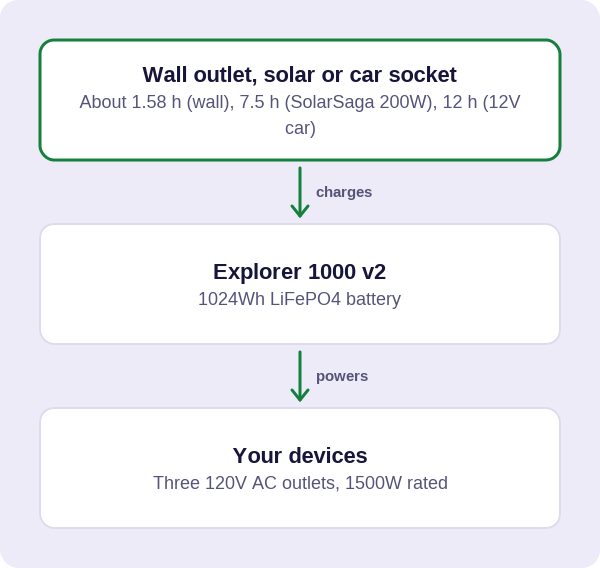
Jackery's product page shows four ways: "Wall Charging", "Solar Charging (200W*2)", "Solar Charging (200W*1)" and "Car Charging". 1
From the wall, the steps are simple. Jackery's FAQ says to "Connect the AC charging cable to the input port of the power station and plug it into the wall outlet". 1 The spec list gives "AC Adapter 1.58 Hours" for a full charge. 1
There's a faster mode too. Jackery lists "Emergency Super Charge 0-100% in 50mins". 1 Jackery says "This emergency charge function can be activated or deactivated through the Jackery app". 1
The other times on the spec list are slower:
- Car socket: "Car Adapter (12V) 12 Hours". 1 - Solar: "Solar Charging 7.5 Hours", in the spec list shown with the SolarSaga 200W kit. 1 Sun, shade and panel angle change that, as Jackery's own FAQ admits. 1
The two DC inputs together take up to "Double to 21A/400W Max". 1 For panels, Jackery adds: "Mixing different models of solar panels is not recommended." 1 And with more than two panels, "the Jackery Solar Panel Connector is required". 1
Temperature matters as well. Jackery gives a charging range of "0°C to 45°C (32°F to 113°F)". 1 Outside that range, Jackery warns, it "may restrict its charging and discharging capabilities". 1 It could even be "unable to charge or discharge". 1 Our guide to charging LiFePO4 batteries gathers makers' cold-weather charging limits.
Original Explorer 1000 vs the v2
If you own the first model, or see one sold used, its figures are quite different. Jackery's information page for the original lists: 2
- Capacity: "1002Wh". 2 - Battery: "Lithium-ion Battery (NCM)", rated for "500 cycles". 2 - AC output: "110V, Max. 1000W Per Port; Max. 1000W Total For 3 Ports." 2 - Wall charging: "Around 7.5H", through an AC adapter rated "24V / 7.5A (Max. Input Power: 180W)". 2 - Car charging: "Around 14H". 2 - Solar with one SolarSaga 200: "1 Panel: Around 9.5H". 2 - USB-C: "Max. 18W", with "No USB-C Input Port". 2
Set side by side, the v2 lists more output (1500W against 1000W), far more rated cycles and much faster wall charging. 1 2 Capacity is close: 1024Wh against 1002Wh. 1 2
Warranties differ too. The original lists "Standard Warranty: 2 Years". 2 It adds "Extendable 1 Year If Registered (For Purchases After 2022), Total 3 Years". 2 For the v2, "Jackery provides 3 years standard warranty and 2 years extended warranty". 1 There's a condition. Jackery only gives it to buyers "from the offcial Jackery website, Jackery-branded third-party platforms, or local authorized dealers." 1
How long it runs: a worked estimate
Divide the battery's watt-hours by the watts your device draws. Using Jackery's 1024Wh figure: 1
- A 50 W load: 1,024 Wh ÷ 50 W = about 20 hours. 1 - A 100 W load: 1,024 Wh ÷ 100 W = about 10 hours. 1 - A 500 W load: 1,024 Wh ÷ 500 W = about 2 hours. 1
These are rough upper limits, and they're our sums, not Jackery's. The inverter that makes AC power uses some energy itself, so real runtimes come out shorter. Jackery's page doesn't list an efficiency figure. Its own runtime calculator says "This is a calculation for reference". 1
Check your appliance's label for its real watts. A fridge cycles on and off, so its average draw is lower than its running figure. Our guide to sizing a power station for a fridge and freezer walks through that sum.
Using it for home backup
The v2 has a switch-over feature for outages. Jackery says it can "Switch power in under 20 milliseconds". 1 That's "for continuous operation of your devices during power outages or voltage fluctuations". 1 You plug the station into the wall and your device into the station. If the grid drops, the station takes over.
Jackery sets limits on what it should run. Its power stations "are not recommended for use with medical devices, life-support equipment, data servers, or other applications" where an interruption could cause harm. 1 Jackery adds that people with "an implanted cardiac pacemaker or other implanted medical devices are advised not to use this product". 1
Never connect the station to a wall outlet to feed power back into your home's wiring. That's backfeeding. Poudre Valley REA warns it's a danger "to the neighboring properties, and to our lineworkers and other first responders". 3 The co-op's answer is a transfer switch, which works by "safely isolating the power source". 3 That switch should be "installed by a professional", it says, and "routinely inspected". 3 So use the station's own outlets, and ask a licensed electrician about anything wired into the house.
A 1 kWh station covers a few essentials, not a whole house. Our home backup sizing walkthrough shows how to add up what you need. For bigger setups, our explainer on wired-in home batteries compares the options.
Frequently asked questions
How do I charge the Jackery Explorer 1000 v2?
From the wall, "Connect the AC charging cable to the input port of the power station and plug it into the wall outlet." 1 Jackery lists "AC Adapter 1.58 Hours", or "Emergency Super Charge 0-100% in 50mins" in emergency charging mode, which "can be activated or deactivated through the Jackery app". 1 It can also charge from solar panels or a 12V car socket.
How much does the Jackery Explorer 1000 v2 cost?
On 24 November 2026, Jackery's US store showed US$559.00 on its own and US$879.00 with a SolarSaga 200W panel, each marked "Sold Out" that day. 1 Prices and stock change, so check the store.
What's the difference between the Jackery Explorer 1000 and the 1000 v2?
The original lists 1002Wh, "Lithium-ion Battery (NCM)" cells, "500 cycles" and 1000W total AC output. 2 The v2 lists 1024Wh, "LiFePO4" cells, "4000 cycles to 70%+ capacity" and "1500W Rated, 3000W Surge peak". 1
How long is the Explorer 1000 v2 warranty?
"Jackery provides 3 years standard warranty and 2 years extended warranty." It applies to buyers "from the offcial Jackery website, Jackery-branded third-party platforms, or local authorized dealers." 1
Can the Explorer 1000 v2 run a CPAP or other medical device?
Jackery says its "portable power stations are not recommended for use with medical devices, life-support equipment, data servers, or other applications where a power interruption could result in personal injury, loss of life, or significant property damage." 1 Ask your doctor or the device's maker about backup power.
Sources
- Jackery Portable Power Station Explorer 1000 v2, Jackery. Checked 24 November 2026.
- Explorer 1000 Basic Information, Jackery. Checked 24 November 2026.
- Understanding The Dangers Of Electric Backfeeding, Poudre Valley REA. Checked 24 November 2026.