Anker vs Jackery in 2026: the 1kWh models side by side
Disclosure: Some links in this guide are affiliate links. If you buy through them we may earn a commission, at no extra cost to you. We only link to products the guide is about. How we make money.
On this page
- The short answer
- Which models this page compares
- Anker C1000 Gen 2 vs Jackery Explorer 1000 v2: the specs
- Charging from the wall and from solar
- Backup during an outage: UPS and pass-through
- How long each one runs: a rough estimate
- Warranty and price on 25 November 2026
- The wider Anker and Jackery ranges
- FAQ
- Sources
- What to do next
The short answer
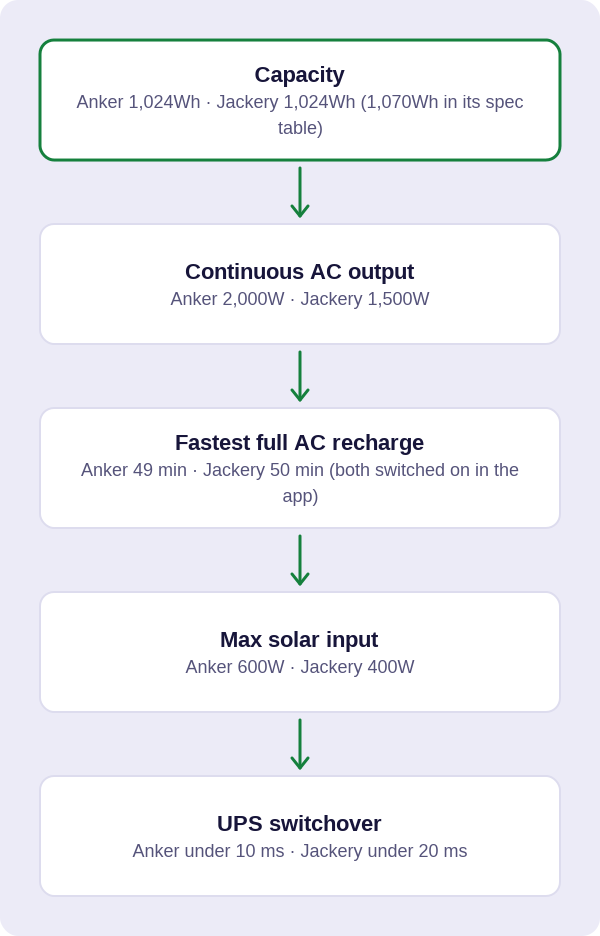
Anker vs Jackery comes down to which model you compare, so this page sets one current 1kWh model from each side by side. Anker lists the SOLIX C1000 Gen 2 at "1,024Wh" with "2,000W output, 3,000W peak". 1 Jackery says the Explorer 1000 v2 "Delivers 1024Wh Capacity and 1500W Output". 4 So they hold about the same energy, while Anker lists more continuous output, more solar input and a shorter UPS switchover. 1 4
Which models this page compares
Anker SOLIX and Jackery both sell power stations from small to very large. A power station is a big rechargeable battery with household outlets and USB ports built in. If that's new to you, our beginner's page on power stations is a good place to start.
Comparing whole brands doesn't say much. So we've picked one model from each at about 1 kilowatt-hour (kWh): the Anker SOLIX C1000 Gen 2 and the Jackery Explorer 1000 v2. 1 4 Both makers sell other models near that size too. Anker's range page still lists the original C1000 at "1,056Wh | 1,800W", and Jackery's lists the HomePower 1000 Plus v2 among others. 3 5
Anker's own page has a comparison table with an unnamed "Other Brand" column. 1 We don't use it here, because Anker doesn't say which product it means.
We haven't used either station. Every figure below comes from the makers' own US pages, read on 25 November 2026. 1 4
Anker C1000 Gen 2 vs Jackery Explorer 1000 v2: the specs
Here are the main figures, Anker first, then Jackery.
- Capacity: "1,024Wh" vs 1024Wh in Jackery's headline. 1 4 Jackery's own spec table lists "30.4Ah/35.2V DC (1070 Wh)", so its two figures differ. 4 - Continuous output: 2,000W vs "1500W Rated". 1 4 - Peak or surge: "3,000W peak" vs "3000W Surge peak". 1 4 - Battery life: "After 4,000 cycles, the battery still has at least 80% capacity" vs "4000 cycles to 70%+ capacity". 1 4 - Weight: "24.9 lb" vs "Around 23.8 lbs (10.8 kg)". 1 4 - Size: 15.12 × 8.19 × 9.61 inches vs "12.87 × 8.82 × 9.72 in". 1 4 - Fastest USB-C port: "(140W Max)" vs "(1x) 100W Max". 1 4
Wh, or watt-hours, is how much energy the battery stores. Watts (W) are how much power it can hand out at once. Surge is a short burst, like the kick a motor needs to start.
Note the cycle ratings use different end points: 80% for Anker, 70% for Jackery. They aren't a like-for-like test. Jackery names its cells as "LiFePO4". 4 Anker's US Gen 2 page doesn't, but its Australian page says "the LFP battery still retains at least 80% capacity". 2 Both terms mean lithium iron phosphate; our LiFePO4 chemistry explainer covers why that matters for battery life.
Charging from the wall and from solar
Both makers have a fast-charge mode you turn on in their app. Anker says the Gen 2 "fully recharges at 1,600W. Enable it in the Anker app." 1 It lists that as 49 minutes. 1 Jackery lists "Emergency Super Charge 0-100% in 50mins". 4 Jackery says this mode "can be activated or deactivated through the Jackery app". 4
Anker's fast mode comes with conditions. It says "UltraFast Charging activates when the battery temperature is above 20 °C (68 °F)". 1 It also advises: "Use only when necessary to prolong the battery lifespan." 1 Without UltraFast Charging, Anker lists "1,200W Max" for AC charging. 1 Jackery's spec list gives "AC Adapter 1.58 Hours" but doesn't say which charging mode that time is for. 4
Solar is where the gap is wider. Anker says you can "Plug in 600W (60V max) of solar and recharge fully in just 1.8 hours." 1 Jackery's two solar inputs together take up to "Double to 21A/400W Max". 4 Jackery adds that "Mixing different models of solar panels is not recommended." 4
Cold matters for both. Anker lists a charging range of "32°F - 104°F". 1 Jackery lists "32~113 °F (0~45°C)". 4
Backup during an outage: UPS and pass-through
Both stations can sit between the wall and a device. If the grid drops, the battery takes over. That's called UPS, short for uninterruptible power supply.
The makers give different switchover times. Anker says the Gen 2 keeps equipment running "with under 10 ms UPS switchover". 1 Jackery says the Explorer 1000 v2 can "Switch power in under 20 milliseconds". 4 A millisecond (ms) is a thousandth of a second. If a short gap would matter for your device, our UPS battery backup guide explains what to look for; click here to read it.
Their advice on medical devices isn't the same. Anker's page names "CPAP machines and laptops" as examples for its UPS feature. 1 Jackery's FAQ takes the opposite line: its stations "are not recommended for use with medical devices, life-support equipment, data servers", it says, among other uses. 4 Before you rely on either for a CPAP, talk to your doctor or the CPAP's maker.
Whichever you buy, plug devices into the station itself. A cord run from the station into a house socket would push power the wrong way down the lines. Electric co-op Poudre Valley REA calls this backfeeding and lists the risk "to the neighboring properties, and to our lineworkers and other first responders". 6 Powering home circuits safely takes a transfer switch, "installed by a professional", the co-op says. 6 For how a 1kWh station fits an outage plan, see our home backup sizing walkthrough for power stations.
How long each one runs: a rough estimate
A simple sum gives an upper limit. Divide watt-hours by the watts your device draws. Both makers give 1,024Wh as a headline figure, so the sums come out the same: 1 4
- A 50W load: 1,024 ÷ 50 = about 20 hours. 1 4 - A 200W load: 1,024 ÷ 200 = about 5 hours. 1 4 - A 1,000W load: 1,024 ÷ 1,000 = about 1 hour. 1 4
These are our estimates, not the makers' figures. Real runtimes are shorter, because turning battery power into household AC uses some energy. Jackery's runtime tool says "This is a calculation for reference." 4 A fridge also cycles on and off, so our fridge and freezer sizing guide walks through that case.
Output matters as much as capacity. Jackery's 1500W rating and Anker's 2,000W rating set the most you can run at once. 4 1 A 1,800W appliance would be over Jackery's rated figure but under Anker's.
Warranty and price on 25 November 2026
Jackery's spec table gives "3+2 Years", and its store shows "5 Years Warranty at Jackery.com". 4 Where you buy matters: the cover is for buyers "from the offcial Jackery website, Jackery-branded third-party platforms, or local authorized dealers." 4 Anker's product page doesn't give a length. Its US portable power station page says "A five-year warranty adds dependable protection for long-term home backup and mobile power." 3 Check the warranty terms where you buy.
Prices were moving with Black Friday sales. On 25 November 2026:
- Anker SOLIX C1000 Gen 2: US$469.99 on ankersolix.com, shown as "Saved $230.00". 1 Anker also said: "Due to high demand, all C1000 Gen 2 orders will ship within 3–7 weeks." 1 - Jackery Explorer 1000 v2: US$559.00 on jackery.com on its own, or US$879.00 with a SolarSaga 200W panel. Both were marked "Sold Out" that day. 4
Those prices change often, so check both stores on the day you buy.
If you'd like more detail on one model, we have separate pages on the Anker SOLIX C1000 and Gen 2 and Jackery's Explorer 1000 and v2. 1 4
The wider Anker and Jackery ranges
Both brands go well beyond 1kWh. Anker's portable power station page describes its S5000 as "approximately 5kWh capacity, expandable to 30kWh, with 4,500W AC output and 120V/240V support". 3 Jackery's power station page lists the Explorer 5000 Plus at "5040Wh Capacity | 7200W Output". 5
Jackery's page also lists much smaller units, such as the Explorer 100D at "96Wh Capacity | 158W Output". 5
Need more than 1kWh without moving up a size? The C1000 Gen 2 "does not include an expansion feature", Anker says, and it points those buyers to the original C1000 instead. 1 Jackery says its HomePower 1000 Plus v2 "offers AC outlets and the option to add a battery for longer use." 5 For a third brand at this size, our EcoFlow Delta 2 vs Delta 3 page makes a useful check.
Frequently asked questions
Is Anker or Jackery better for home backup?
Neither maker's page settles that, and we haven't tested them. On their own figures, Anker's C1000 Gen 2 lists "2,000W output" and "under 10 ms UPS switchover". 1 Jackery's Explorer 1000 v2 lists "1500W Rated" and a switch "in under 20 milliseconds". 4 Match the output to what you need to run.
Which charges faster, the Anker C1000 Gen 2 or the Jackery Explorer 1000 v2?
With fast modes on in each app, Anker lists 49 minutes, and Jackery lists "Emergency Super Charge 0-100% in 50mins". 1 4 On solar, Anker takes up to "600W (60V max)" and Jackery up to "21A/400W Max" across its two inputs. 1 4
Do Anker and Jackery use LiFePO4 batteries?
Jackery names "LiFePO4" cells for the Explorer 1000 v2. 4 Anker's Australian C1000 Gen 2 page says "the LFP battery still retains at least 80% capacity" after 4,000 cycles. 2 LFP and LiFePO4 both mean lithium iron phosphate.
How long is the warranty on Anker and Jackery power stations?
For the Explorer 1000 v2, Jackery's spec table shows "3+2 Years", and Jackery ties that cover to buying from its own site, Jackery-branded platforms or authorized dealers. 4 Anker's C1000 Gen 2 page doesn't state a warranty length. Its US power station range page mentions "A five-year warranty" without naming models, so ask Anker or the seller what covers the model you buy. 3
Sources
- Anker SOLIX C1000 Gen 2 Portable Power Station - 1,024Wh | 2,000W, Anker SOLIX. Checked 25 November 2026.
- Anker SOLIX C1000 Gen 2 (Australia), Anker SOLIX. Checked 25 November 2026.
- Anker SOLIX portable power stations, Anker SOLIX. Checked 25 November 2026.
- Jackery Portable Power Station Explorer 1000 v2, Jackery. Checked 25 November 2026.
- Jackery portable power stations, Jackery. Checked 25 November 2026.
- Understanding The Dangers Of Electric Backfeeding, Poudre Valley REA. Checked 25 November 2026.