UPS battery backup: what it is and how to size one
Disclosure: Some links in this guide are affiliate links. If you buy through them we may earn a commission, at no extra cost to you. We only link to products the guide is about. How we make money.
On this page
The short answer
A UPS battery backup is a box with a battery inside that your computer or router plugs into. APC describes a UPS (Uninterruptible Power Supply) as "a battery backup system that provides instant emergency power during outages". It's built for short outages: APC says basic units "often provide 5–15 minutes for safe shutdowns". 1
What is a UPS battery backup?
A UPS sits between the wall outlet and your gear. When the power drops, its battery takes over.
The APC buying guide, on Schneider Electric's website, says a UPS "provides instant emergency power during outages and protects connected devices from power spikes and failures". 1 Its guide lists three jobs. Power continuity "Delivers battery power immediately when the main grid fails". Voltage regulation "Corrects brownouts and over-voltages". Surge suppression "Shields equipment from destructive electrical spikes". 1
A brownout is a dip in voltage. A surge or spike is a short jump above it.
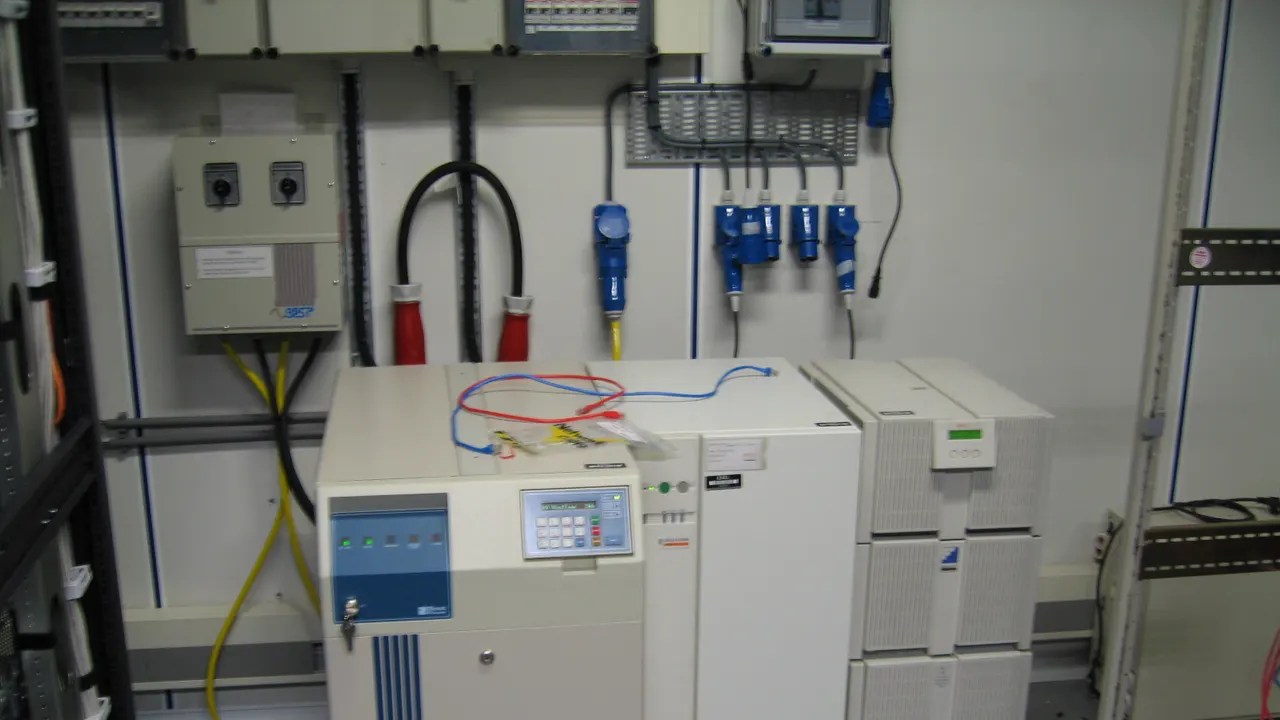
Sizes vary a lot. Wikipedia says UPS units range from "around 200 volt-ampere rating" for a single computer without a monitor "to large units powering entire data centers or buildings". 3 This page is about the small kind that sits under a desk.
What does UPS stand for in battery backup?
UPS stands for uninterruptible power supply. Wikipedia gives a second name too: "uninterruptible power source". 3
The "uninterruptible" part is the point. Wikipedia says a UPS differs from a standby generator "in that it will provide near-instantaneous protection from input power interruptions". 3 In plain terms, the handover to battery is close to instant.
The three main types
Wikipedia names "on-line, line-interactive and standby" as the three general categories. 3
Standby (offline). Wikipedia says that in this kind "the load is powered directly by the input power and the backup power circuitry is only invoked when the utility power fails". 3
Line-interactive. This kind "is able to tolerate continuous undervoltage brownouts and overvoltage surges without consuming the limited reserve battery power". 3
Online (double conversion). APC says it "continuously runs devices off its inverter, completely isolating them from grid fluctuations". 1
For a home office, APC's advice is short: "For home and office use, line interactive is usually sufficient". 1 Its own home and office models are listed as "Line interactive," with a typical power capacity of "650–1500 VA". 1
How to size a UPS battery backup
Sizing starts with the watts of everything you'll plug in. APC says "A UPS should have a VA rating higher than your total device watt load". It adds: "Add up your devices' wattage and choose a model with extra VA capacity to handle peaks and avoid overloads". 1
UPS ratings use two units. APC notes that "For computers and UPS systems, watt and VA ratings differ; VA is usually higher". It explains: "VA (volt-amperes) measures the total power a UPS can handle, while watts measure the actual power your devices consume". The gap between them is "power factor, typically 0.6 to 0.9 for most equipment". 1
APC's own worked example is "500W ÷ 0.8 = 625 VA minimum". 1 Then it says to "choose a UPS with a VA rating 20–30% higher than your calculated load". 1
Carrying APC's example one step further gives our own estimate. 625 VA × 1.2 = 750 VA, and 625 VA × 1.3 = about 813 VA. 1
So for a 500 W load, and only at the 0.8 power factor in APC's example, APC's method points to a UPS of roughly 750 to 813 VA or more. Gear with a lower power factor needs more VA: at 0.6, the bottom of APC's range, 500 W ÷ 0.6 = about 833 VA before any margin. 1
One snag. The same APC page gives a slightly different margin elsewhere: "ensure output watt capacity is 20–25% above load". 1 So check the UPS's watt rating as well as its VA rating, and leave room on both.
Look for each device's watts on its label or in its manual. Use those numbers, not a guess.
How long does a UPS battery backup last?
People mean two things by this. How long it runs in an outage, and how many years its battery lasts.
Runtime in an outage. APC defines runtime as "the duration your UPS can power connected devices during an outage". 1 For its home and office units it gives "Short runtime intended for graceful shutdown" and "5–20 minutes depending on load and model". In its FAQ it says "Basic units often provide 5–15 minutes for safe shutdowns". 1 Wikipedia says the run-time of most units is "relatively short (typically ranging from 5 to 15 minutes)". 3
The load matters. APC says "More connected equipment reduces available runtime, so it’s important to reserve backup power for only your most essential devices". 1 Plug in what you need, and leave the rest off the battery.
Battery life in years. APC lists its home and office units with a "Lead-acid" battery, with "Replacement battery cartridges available dependent on model (recommended every 2-5 years)". 1 For its business range it lists "Lead-acid or lithium-ion options (e.g., Smart-UPS Ultra), offering 8–10-year battery life". 1 Those are APC's figures for its own products. Check your model's manual for its replacement advice. For more on battery chemistry, read about LiFePO4 versus other lithium-ion batteries. A whole-home battery raises the same question, as our page on how many hours and years a Powerwall lasts shows.
Computers, modems and routers
APC says a UPS "keeps your devices running long enough to safely shut down or maintain operations during short outages, helping prevent data loss and equipment damage". 1
On speed, APC says a line-interactive UPS switches to battery "fast enough for most computers and network gear". 1
Some units split their outlets. APC describes surge-only outlets as ones that "Protect secondary electronics from surges and spikes without reducing battery power used to run primary electronics during outages". 1 One of its Back-UPS models, the BE600M1, is listed as "APC Back-UPS 600VA, 120V, 1 USB charging port, 7 NEMA outlets (2 surge)". 2
As a plan, put the things you can't lose on the battery side, such as the computer tower, the modem and the router. Read your own model's manual and labels before you plug anything in.
UPS or surge protector?
These two don't do the same job. APC puts it plainly: "A surge protector guards devices against sudden voltage spikes but provides no power during an outage". 1
A UPS covers both. APC says it "does everything a surge protector does, plus supplies battery backup power so you can save work and shut down safely". 1
APC's advice is that if you rely on "a computer, network equipment, or any device where unexpected shutdowns cause data loss or damage, a UPS is the right choice — not a surge protector". 1
When you need hours, not minutes
A desk UPS is built for minutes. APC describes its home and office units as having "Short runtime intended for graceful shutdown". 1 Wikipedia says the run-time of most units is "relatively short" but "sufficient to start a standby power source or properly shut down the protected equipment". 3
If you want a fridge, lights or a router running for hours, you're shopping for something bigger. Our portable power station basics cover the plug-in kind, and sizing a power station for home backup walks through watts and watt-hours. For a wired-in system, start with how a home battery backup works. That kind is installed by a licensed electrician.
We haven't used any of these units, and we don't rank them. Compare the maker's own ratings for VA, watts and runtime.
Frequently asked questions
What is a UPS battery backup?
It's a device with a battery that your electronics plug into. APC describes a UPS as "a battery backup system that provides instant emergency power during outages". 1
What does UPS stand for?
Uninterruptible power supply. Wikipedia also calls it an "uninterruptible power source". 3
How do I size a UPS battery backup?
Add up the watts of what you'll plug in. APC says "A UPS should have a VA rating higher than your total device watt load," and suggests a VA rating "20–30% higher than your calculated load". Elsewhere it says "ensure output watt capacity is 20–25% above load". 1
How long does a UPS battery backup last in a power outage?
For a basic unit, usually minutes. APC says "Basic units often provide 5–15 minutes for safe shutdowns," and its home and office table says "5–20 minutes depending on load and model". 1
How often does a UPS battery need replacing?
For its home and office units, APC says "Replacement battery cartridges available dependent on model (recommended every 2-5 years)". 1 Check your own model's manual.
Sources
- UPS buying guide: Choose the right backup, Schneider Electric (APC). Checked 18 November 2026.
- APC Back-UPS 600VA, 120V, 1 USB charging port, 7 NEMA outlets (2 surge), APC by Schneider Electric. Checked 18 November 2026.
- Uninterruptible power supply, Wikipedia. Checked 18 November 2026.