How long does a LiFePO4 battery last? Hours and years
Disclosure: Some links in this guide are affiliate links. If you buy through them we may earn a commission, at no extra cost to you. We only link to products the guide is about. How we make money.
On this page
- The short answer
- Two questions in one
- How long will a 100Ah LiFePO4 battery last on one charge?
- Why your hours will differ
- Is one 100Ah battery enough for a home outage?
- How many years does a LiFePO4 battery last?
- A home backup example: the EcoFlow DELTA 2
- What shortens or stretches a LiFePO4 battery's life
- FAQ
- Sources
- What to do next
The short answer
How long a LiFePO4 battery lasts has two answers. On one charge, Anker SOLIX says a 12.8V 100Ah battery "stores about 1,280 watt-hours" and can run a 100W load "for about 12.8 hours" under ideal DC conditions. 1 In years, Renogy says LiFePO4 batteries "can endure over 4,000 full charge-discharge cycles, often lasting more than ten years with daily use." 2
Two questions in one
People ask how long a LiFePO4 battery lasts for two different reasons. Some mean the hours it runs their gear during an outage. Others mean the years before it wears out.
LiFePO4 stands for lithium iron phosphate, one type of lithium battery. Our plain-English guide to what LiFePO4 is covers the chemistry. This page sticks to time: hours first, then years.
How long will a 100Ah LiFePO4 battery last on one charge?
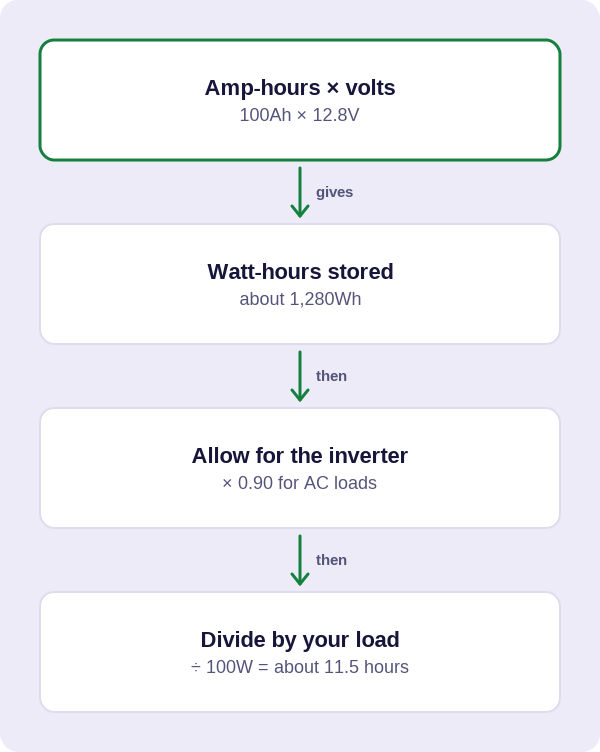
Start with energy, not amp-hours. Anker SOLIX says "A standard 12V 100Ah lithium battery, usually a 12.8V LiFePO4 model, stores about 1,280 watt-hours of energy." 1 That's 100Ah × 12.8V.
Then divide by the load. Anker's formula is "Backup Time = Usable Battery Capacity in Wh × Inverter Efficiency ÷ Total Appliance Load in Watts". 1 For AC appliances, it says to "use about 0.85 to 0.90 unless your inverter provides a specific efficiency rating." 1
Its own worked example is a 100W load through an inverter: "1,280Wh × 0.90 ÷ 100W = 11.5 hours." 1 Its table, for the same 1,280Wh battery, includes:
- 50W: "25.6 hours" ideal DC. "23.0 hours" with a 90% efficient inverter. - 200W: "6.4 hours" DC. "5.8 hours" AC. - 500W: "2.6 hours" DC. "2.3 hours" AC. - 1000W: "1.3 hours" DC. "1.1 hours" AC. 1
Anker adds: "These numbers are estimates, not guarantees." 1
Why your hours will differ
Anker lists what moves the number: "Load size, battery voltage, inverter efficiency, temperature, discharge limits, and battery age all affect actual runtime." 1
Appliances don't draw a steady load either. "Real appliances cycle on and off, surge at startup, or draw more power than the label suggests," Anker says. 1 A fridge is the classic case.
Not all of the stored energy may be usable. Anker says "LiFePO4 batteries often provide 80%–100% usable capacity". 1 Its advice is to "Plan for less runtime if the battery is cold, older, or powering devices with startup surges." 1
Want to size a battery for a fridge? Our walk-through on battery size for a fridge or freezer does the sums.
Is one 100Ah battery enough for a home outage?
For a few small things, maybe. Anker says that for home outages, a 100Ah lithium battery "can keep a router online, charge phones, power LED lights, run a laptop, or support some CPAP machines". 1
It's blunt about the limits too. Anker says it "is usually not enough for whole-home backup, electric heating, air conditioning, or long-term off-grid living by itself." 1
Need more than that? Bigger systems are measured in kilowatt-hours. Our explainer on how home battery backup works covers kWh and kW. Any battery that's wired into your home's circuits is a job for a licensed electrician.
How many years does a LiFePO4 battery last?
Makers rate life in cycles. Renogy defines one: "A cycle is one complete charge and discharge." 2
Renogy's headline figure comes first. LiFePO4 batteries "can endure over 4,000 full charge-discharge cycles, often lasting more than ten years with daily use." 2 Lower down, in its FAQ, the same article gives a lower figure. It says "Under the same operating circumstances, the service life of a LiFePO4 battery generally varies from 7 to 8 years". 2 So treat any number of years as a rough guide, not a promise.
Cycle ratings vary by product. For its own Pro S1 series, Renogy quotes "6,000 cycles (retaining 80% capacity)" and "16+ years of reliable power with one full charge cycle per day". 2
A quick sum shows how cycles turn into years. Take Renogy's 4,000 cycles. 2 At one full cycle a day, that's 4,000 ÷ 365, or about 11 years. That's our estimate. A battery that mostly waits for outages will cycle less often than that.
A home backup example: the EcoFlow DELTA 2
Power stations for home backup often use LiFePO4 too. EcoFlow's DELTA 2 page says: "Get 10 years of daily use until hitting 80% of its original capacity." 3 It credits "LiFePO4 battery chemistry giving you 3000+ full charge and drain cycles". 3
Note the "80%" there. The rating is for the battery still holding 80% of its original capacity, not for the day it stops working. The warranty is separate: EcoFlow's page lists a "5 Year Warranty". 3
If you're weighing up power stations for this, our guide to a portable power station for home backup covers sizing, output and a runtime estimate.
What shortens or stretches a LiFePO4 battery's life
Renogy lists the factors. On depth of discharge, it says "Using too much of the battery's capacity before recharging can shorten life." 2
On charging: "Use a charger designed for LiFePO4 to maintain correct voltage and current." 2 Our page on charging a LiFePO4 battery goes into chargers and cold weather.
On heat and cold, Renogy says "Best performance occurs between 0°C and 45°C" (32°F to 113°F). 2
On storage, Renogy is specific. "For long-term storage, keep the battery in a cool, dry place at ~50% charge to prevent capacity loss and maintain integrity." 2 Your own battery's manual comes first, though, since makers' advice can differ.
Frequently asked questions
How long will a 100Ah LiFePO4 battery run a 100W load?
Anker SOLIX gives "about 12.8 hours" under ideal DC conditions, or "1,280Wh × 0.90 ÷ 100W = 11.5 hours" through a 90% efficient inverter. 1 Those are estimates.
How many cycles does a LiFePO4 battery last?
Renogy says LiFePO4 batteries "can endure over 4,000 full charge-discharge cycles". 2 EcoFlow rates the DELTA 2 at "3000+ full charge and drain cycles". 3 Check the rating for your own model.
Does a LiFePO4 battery stop working after its rated cycles?
Not necessarily. EcoFlow's DELTA 2 figure is for use "until hitting 80% of its original capacity." 3 Renogy's Pro S1 rating also says "retaining 80% capacity". 2
How should I store a LiFePO4 battery between outages?
Follow your battery's manual first. Renogy's general advice is to "keep the battery in a cool, dry place at ~50% charge" for long-term storage. 2
Sources
- How Long Does a 100Ah Lithium Battery Last?, Anker SOLIX. Checked 26 November 2026.
- How Long Do LiFePO4 Batteries Last?, Renogy. Checked 26 November 2026.
- EcoFlow DELTA 2 Portable Power Station, EcoFlow. Checked 26 November 2026.