Anker SOLIX C1000 and C1000 Gen 2 explained
Disclosure: Some links in this guide are affiliate links. If you buy through them we may earn a commission, at no extra cost to you. We only link to products the guide is about. How we make money.
On this page
The short answer
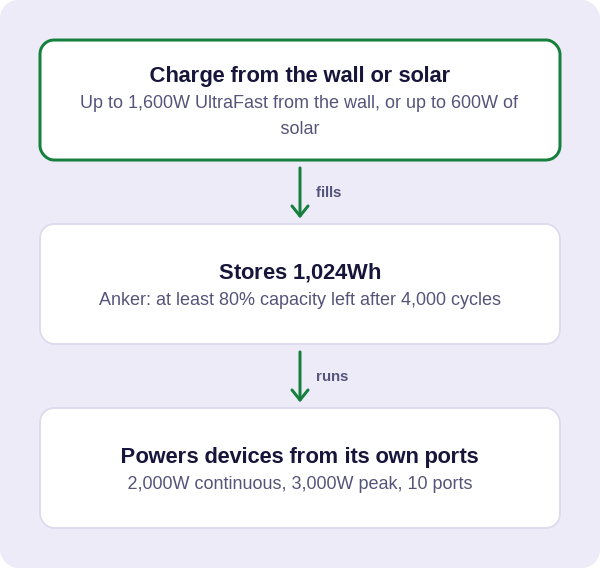
The Anker SOLIX C1000 is a portable power station, and there are two versions. Anker's spec table for the original lists "1056Wh" of capacity and "1800W Pure Sine Wave" output. 2 The newer C1000 Gen 2 lists "1,024Wh" and "2,000W output, 3,000W peak". 1 With UltraFast Charging on in the Anker app, it recharges fully at 1,600W in 49 minutes. 1 Both charge from a wall outlet or solar, and both can run small appliances during an outage from their own outlets. 2 1
What the Anker SOLIX C1000 is
The C1000 is a mid-size power station from Anker SOLIX. It's a big battery with household outlets, USB ports and a car socket built in. You charge it before a storm, then plug lamps, phones, a laptop or a small appliance straight into it. Our plain-English guide to power stations explains how the whole category works.
Two models share the name. The original C1000 came first. The C1000 Gen 2 is the newer one, and Anker's own comparison table sets them side by side. 1 They're close in size but differ in charging speed, output and expansion.
One naming quirk. Anker's US page for the original is titled "Anker SOLIX C1000X Portable Power Station 1056Wh | 1800W", while its spec table is headed "C1000 Portable Power Station". 2 This page uses the figures from that spec table.
Nobody here has used either model. Every figure below is Anker's, taken from its pages on 24 November 2026. 1 2
C1000 vs C1000 Gen 2: the specs side by side
Anker's Gen 2 page has a table comparing the two. 1 Here are its rows, Gen 2 first, then the original.
- Capacity: 1,024Wh vs 1,056Wh. 1 - Output: 2,000W vs 1,800W, each with "(3,000W Peak Output)". 1 - Max AC input: 1,600W vs 1,300W. 1 - AC recharge to 100%: 49 min vs 58 min. 1 - Solar input: "600W, 60V Max" for both. 1 - UPS switchover: 10 ms vs 20 ms. 1 - Expandable capacity: no vs yes. 1
Weight comes from each spec list. It's "24.9 lb" for the Gen 2 and "28.44 lb / 12.9 kg" for the original. 1 2
The original's own spec list words its surge rating differently. It gives "AC Surge Output: 2400W" and "Run 2,400W Loads With SurgePad", which differs from the 3,000W peak in the comparison table. 2 1 Anker says SurgePad "activates when total output exceeds rate output". 2 It adds that "Heat-generating devices work best". 2 And it "does not support precision instruments and other devices with voltage protection or a strict voltage requirement." 2
Wh, or watt-hours, is how much energy the battery holds. Watts are how much power it can deliver at once.
Anker SOLIX C1000 Gen 2: what changed
Charging speed is the headline on Anker's Gen 2 page. "With upgraded HyperFlash technology, it fully recharges at 1,600W. Enable it in the Anker app." 1 Without UltraFast Charging, the spec table lists "1,200W Max" for AC charging. 1
There's a temperature condition. Anker says "UltraFast Charging activates when the battery temperature is above 20" degrees Celsius (68°F), and charging between 0 and 20°C "will significantly reduce charging speed". 1 It also advises: "Use only when necessary to prolong the battery lifespan." 1
The Gen 2 can't take an extra battery. Anker's FAQ says it "does not include an expansion feature". 1 It goes on: "For users who need expandable capacity, C1000 is recommended." 1 The original is "Expandable to 2,112Wh" with Anker's expansion battery. 2
Anker's page lists a few other Gen 2 features. It has an LCD screen and a "Time-of-Use (TOU)" mode in the app. 1 Its ports include a USB-C rated "(140W Max)", USB-A, a car socket and AC outlets. 1 On 24 November 2026, the page also said: "Due to high demand, all C1000 Gen 2 orders will ship within 3–7 weeks." 1
How to charge it
Both models charge from a wall outlet or from solar panels. 2 1
- Gen 2 from the wall: "120V~ 12A Max, 60Hz", at "1,200W Max", or 1,600W with UltraFast Charging. 1 - Gen 2 from solar: "Plug in 600W (60V max) of solar and recharge fully in just 1.8 hours." 1 - Original from the wall: "Max. 1300W", with Anker quoting "0-100% in 58 mins". 2 - Original from solar: "Max. 600W, 11-60V MPPT". Anker's FAQ says to "Use an 11-60V solar charger with an XT-60 connector." 2
Wall and solar together work differently on each model. Anker says the Gen 2 "can be charged via both the grid and solar panels simultaneously". 1 Solar comes first, "with solar power prioritized and any remaining capacity supplied by AC charging". 1 For the original, it says "This is not possible. AC input is prioritized if both AC and DC inputs are connected." 2
Anker lists the same charging temperature for both: "32°F - 104°F". 1 2 Solar panels are sold separately on both product pages. 1 2
Can the Anker SOLIX C1000 power a fridge?
Anker suggests so. Its Gen 2 page lists "Refrigerator (100W)" in a section titled "Stay Ahead of Any Outage". 1 The Gen 2 is rated for "2,000W continuous power" and the original for "1800W Pure Sine Wave" output. 1 2 Pure sine wave means the outlets give the same smooth kind of power as the grid.
Here's a rough upper limit, as our own estimate. Say a fridge draws a steady 100 watts. It would use the Gen 2's full 1,024Wh in 1,024 ÷ 100 = about 10 hours. On the original's 1,056Wh, it's about 10.5 hours. Real runtime will be shorter, because some energy is lost turning battery power into AC. Its compressor also switches on and off through the day. So the label figure is only a starting point. Anker's own note says "Listed runtimes are based on single-device usagee" (Anker's spelling). 1
So check the watts on your fridge's label before you plan around it. Working out fridge and freezer runtime takes a few more steps, which our sizing page shows.
How long does the Anker SOLIX C1000 last?
There are two answers: how long it runs on one charge, and how many years the battery lasts.
Runtime depends on what you plug in. Divide the capacity by your device's watts for a rough upper limit, as in the fridge example above. The Gen 2 holds 1,024Wh. 1 So a 50W load gives 1,024 ÷ 50 = about 20 hours, before conversion losses. That's our estimate, not Anker's figure.
For battery life, Anker rates the original at "3,000 cycles to 80%+ capacity", with a "LiFePO4 (Lithium Iron Phosphate)" battery. 2 For the Gen 2 it says: "After 4,000 cycles, the battery still has at least 80% capacity." 1 Anker's US Gen 2 page doesn't name the chemistry. Its Australian page says "the LFP battery still retains at least 80% capacity". 3 LFP is short for lithium iron phosphate, and our LiFePO4 explainer explains what a cycle rating means.
For storage, Anker's original C1000 FAQ says to "Check battery capacity each week. If the battery level is below 30%, charge to 100%. Fully charge once every 3 months." 2
Using it for home backup
Both models have a UPS feature. UPS stands for uninterruptible power supply: if the grid drops, the station takes over the load. Anker says the Gen 2 can "Keep vital equipment like CPAP machines and laptops running with under 10 ms UPS switchover." 1 Its comparison table lists 20 ms for the original. 1 If you need a UPS for a computer or medical device, our UPS backup page covers what to compare; click here to read it.
Anker lists safety certifications for the original: "Anker SOLIX C1000 is certified by SGS in accordance with UL 1012, UL 1778, UL 1973, and UL 60730." 2
These are plug-in stations. You run devices from their own outlets, and they aren't wired into the house. Never plug a power station into a wall outlet to push power back into your home. That's called backfeeding. Poudre Valley REA, an electric co-op, warns it's a danger "to the neighboring properties, and to our lineworkers and other first responders". 5 A transfer switch is the safe way to feed home circuits, by "safely isolating the power source". 5 The co-op says it should be "installed by a professional". 5
For how a station like this fits into an outage plan, see our guide to power stations for home backup.
Warranty and price
The original C1000's spec list gives a "5-Year Warranty". 2 Anker's US warranty policy lists both the C1000 and the C1000 Gen 2 in its 60-month group, which is five years. 4 It applies to "purchases made on ankersolix.com", and "The warranty period starts from the date of purchase." 4
Prices move a lot around Black Friday, and Anker's US pages were running a sale on 24 November 2026. 1 Anker's store loads its prices after the page opens, so check the live Gen 2 page for today's price in US dollars before you buy.
Looking at other makers too? Our Anker vs Jackery comparison sets the Gen 2 beside Jackery's 1kWh model, and our overview of Bluetti power stations covers a different range. Bluetti's Elite models are covered in our guide to the Bluetti Elite line too.
Frequently asked questions
What is the difference between the Anker SOLIX C1000 and C1000 Gen 2?
Anker's comparison table lists the Gen 2 at 1,024Wh and 2,000W output with a 49-minute AC recharge, against 1,056Wh, 1,800W and 58 minutes for the original. 1 The original can add an expansion battery; the Gen 2 "does not include an expansion feature". 1
Can the Anker SOLIX C1000 power a fridge?
Anker lists "Refrigerator (100W)" on its Gen 2 page. 1 As our rough estimate, a steady 100W load would use the Gen 2's 1,024Wh in about 10 hours at most. It'd be less in practice, because of conversion losses. Check your fridge's label watts first.
Sources
- Anker SOLIX C1000 Gen 2 Portable Power Station - 1,024Wh | 2,000W, Anker SOLIX. Checked 24 November 2026.
- Anker SOLIX C1000X Portable Power Station 1056Wh | 1800W, Anker SOLIX. Checked 24 November 2026.
- Anker SOLIX C1000 Gen 2 (Australia), Anker SOLIX. Checked 24 November 2026.
- Anker Portable Power Station Warranty Policy, Anker SOLIX. Checked 24 November 2026.
- Understanding The Dangers Of Electric Backfeeding, Poudre Valley REA. Checked 24 November 2026.