Portable power station for sump pump backup: what to check
Disclosure: Some links in this guide are affiliate links. If you buy through them we may earn a commission, at no extra cost to you. We only link to products the guide is about. How we make money.
On this page
- The short answer
- Can a power station run a sump pump?
- How many watts does a sump pump use?
- Surge: why the start matters most
- How long a power station runs a sump pump
- Why a cycling pump lasts much longer
- Where to put the power station
- Plug the pump into the station, never the house
- Test it and plan the recharge
- FAQ
- Sources
- What to do next
The short answer
A portable power station for sump pump backup has to pass two tests. Its surge rating must cover the pump's startup, and its battery must last between charges. EcoFlow says "Runtime comes down to usable battery energy and the number of minutes the pump operates each hour". EcoFlow's and Bluetti's own tables give a pump of about 800W roughly two hours of nonstop pumping on a station of about 2 kWh. A pump that cycles on and off lasts much longer. 1 2
Can a power station run a sump pump?
Yes, if it's big enough in two ways. Power station makers EcoFlow and Bluetti both publish guides on running a sump pump. 1 2 EcoFlow puts the job plainly: "The system must start the motor, hold enough stored energy between charging opportunities, and remain safely positioned if water enters the basement". 1
That gives you three things to check. Output, which is how much power the station can deliver at once. Capacity, which is how much energy it stores, in watt-hours (Wh). And placement, because water and electricity don't mix.
A power station is one way to back up a pump. Dedicated battery backup kits and generators are the others. Our page on sump pump battery backup vs a generator compares those two; click here to read it.
How many watts does a sump pump use?
Start with your own pump's label. EcoFlow says "The pump label or manual should list voltage, amperage, wattage, or locked-rotor current". It adds that "The manufacturer's rating is the number to trust". 1
Horsepower alone won't tell you. EcoFlow says "Horsepower is a measure of mechanical output, not of what the pump pulls from the outlet". 1 Makers' rough figures also differ. Bluetti lists "1/3 HP: ~800W running | 1,300–2,900W surge" and "1/2 HP: ~1,050W running | 2,150–4,100W surge". 2 EcoFlow only says home pumps "generally land in the several-hundred-watt range". 1
If the label doesn't give the starting figure, EcoFlow says to "consult the manufacturer if the startup requirement is not provided". 1
Surge: why the start matters most
An electric motor pulls a burst of power as it starts. EcoFlow says "An electric motor draws far more power at the moment it starts than it does while it runs". 1 Bluetti calls this the starting surge, "often 2x to 5x the running wattage". 2
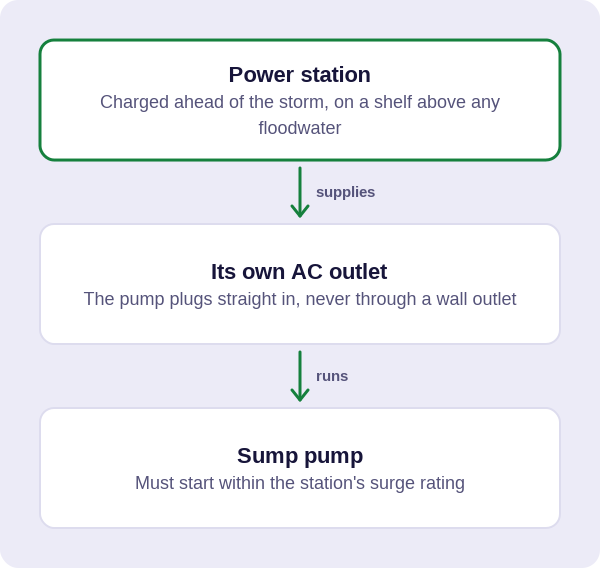
This is where many setups fail. EcoFlow warns that "A unit chosen based on running watts alone can look perfectly adequate and still fail whenever the float switch activates the pump". 1 The float switch is the part that turns the pump on when the water rises.
So compare two numbers. The station's surge rating must beat the pump's starting watts. Its rated output must beat the running watts. EcoFlow's words are "Both numbers have to pass". 1 It also notes that "Manufacturers do not all define or test surge ratings the same way", so leave extra room when the numbers are close. 1 For more on output and surge ratings, see our home backup power station sizing guide.
How long a power station runs a sump pump
Each maker publishes runtimes for a pump running nonstop. These are their own estimates, not tests of your pump.
- EcoFlow works it out with "Runtime = usable battery capacity ÷ pump wattage" and an "illustrative 85% usable-capacity assumption". Its table gives "2,048Wh About 3.5 hours About 2.2 hours About 1.7 hours" for 500W, 800W and 1,000W pumps. 1
- Bluetti uses "(Battery Wh × 0.8) ÷ Running Watts". It lists the "Elite 200 V2 2,073.6Wh ~2.1 Hours ~1.6 Hours ~1.1 Hours" for 1/3, 1/2 and 3/4 HP pumps. 2
The usable share isn't 100% because the station turns stored DC power into AC power for the pump. EcoFlow says "Converting between the two consumes some of the stored energy". 1 Our explainer on what limits how long a power station lasts covers capacity in more detail.
Why a cycling pump lasts much longer
A sump pump doesn't usually run all the time. It empties the pit, then waits for it to fill. EcoFlow says "Most sump pumps do not run continuously". 1
EcoFlow's example is a 500W pump that runs 10 minutes in every hour: "500W × 10/60 hour = 83Wh per hour". 1 Here's our own rough estimate from those figures. On a 2,048Wh station, EcoFlow's 85% assumption leaves about 1,741Wh (2,048 × 0.85). Divide that by 83Wh per hour and you get about 21 hours. Treat that as a ballpark, not a promise.
Bluetti does the same for a 1/3 HP pump cycling "10 to 15 minutes per hour". It says the "Elite 200 V2: Provides ~8.3 to 12.4 hours of protection". 2
Heavy rain changes everything. EcoFlow warns "The cycle pattern can change quickly as rainfall and groundwater levels increase". 1 Plan for a worse storm than the last one.
Where to put the power station
Keep it high and dry. EcoFlow says to "Place the unit on a stable elevated surface above the highest water level the basement could reasonably reach". It adds "Do not position it on the floor beside the sump basin". 1
If the basement starts to flood, stay out. EcoFlow says "If water approaches any electrical connection, do not enter the area to retrieve equipment". 1
A battery station can sit indoors, unlike a fuel generator. EcoFlow says "A battery power station is suitable for indoor operation when used according to its manual". It still says "Do not seal the unit inside a cabinet or cover its air vents". 1
Plug the pump into the station, never the house
Plug the sump pump straight into the power station's own AC outlet. Never try to feed a power station's output into a wall outlet to power the house circuits. Safe Electricity gives that rule for portable generators: "Never plug a portable electric generator into a wall outlet or connect directly to a home's wiring". 3
If you want the station to power a house circuit, that's an electrician's job. EcoFlow says "Permanent wiring, transfer equipment, or changes to a household circuit should be completed by a qualified electrician in accordance with local codes". 1 Our page on transfer switches for backup power explains what that equipment does.
Some stations can switch over on their own when the grid fails. Don't assume yours does. EcoFlow says "Do not assume that every AC output functions as an automatic backup supply". 1
Test it and plan the recharge
Test the whole setup before storm season. EcoFlow says to "Confirm that the inverter starts the pump without overload warnings and that water discharges normally". It adds that you should "Repeat the test several times, because one successful start does not prove that every startup will remain within the system's limit". 1
Then plan how to recharge during a long outage. EcoFlow lists options including "Compatible solar panels during suitable daylight" and "A compatible generator operated outdoors". 1 It also warns that "Solar production varies with weather and may be limited during the same storm that causes the outage". 1 If you'd rather not rely on recharging, a fuel generator runs as long as it has fuel. Our page on a battery compared with a gas generator weighs the two.
Frequently asked questions
What size power station do I need for a sump pump?
Check your pump's running and starting watts first. The station's surge rating must cover the start and its rated output must cover the running load. Bluetti lists a 1/2 HP pump at "~1,050W running | 2,150–4,100W surge", but your pump's label is the figure to use. 2 1
How long will a power station run a sump pump?
For nonstop pumping, EcoFlow estimates "2,048Wh About 3.5 hours About 2.2 hours About 1.7 hours" for 500W, 800W and 1,000W pumps. 1 A pump that cycles on and off can last far longer, so the answer depends on how fast water comes in.
Can a 1,000W power station run a sump pump?
Maybe not. EcoFlow says "A 1,000W output rating may cover the running load but still be unable to handle motor startup". 1 Compare the pump's surge figure with the station's surge rating.
Is a backup battery for a sump pump the same as a power station?
Not quite. A power station is a general plug-in battery with AC outlets. Dedicated sump pump battery kits are built around the pump. Our page on sump pump battery backup compared with a generator covers those kits.
Sources
- Portable Power Station for Sump Pump: Size and Runtime, EcoFlow. Checked 27 November 2026.
- How Long Can a BLUETTI Portable Power Station Power a Sump Pump?, Bluetti. Checked 27 November 2026.
- Use Caution When Using Back-Up Generators, Safe Electricity. Checked 27 November 2026.