Battery vs gas generator: choosing home backup power
Disclosure: Some links in this guide are affiliate links. If you buy through them we may earn a commission, at no extra cost to you. We only link to products the guide is about. How we make money.
On this page
The short answer
In a battery vs gas generator choice for backup, the main split is how long your outages last. Generac, which sells both, lists a battery for "Short outages (a few hours)" and a standby generator for "Long-duration outages (days or even weeks)". Many homes can also pair the two. 1
The short version
A home battery stores energy. A generator burns fuel to make it. Nearly every difference between them comes from that.
Generac makes both standby generators and solar batteries, so its guide is a useful place to start. It lists a battery as a fit for "Short outages (a few hours)" and for "Running essential circuits (refrigerator, lights, Wi-Fi)". 1 It lists a standby generator for "Long-duration outages (days or even weeks)" and for "Homes with high electrical demand". 1
Neither one wins for every home. Anker SOLIX, a battery maker, says "Either solution can serve essential circuits or a whole home". The catch, in its words: "the design must match the panel, startup surges, continuous load, and the homeowner's priorities." 2
How long each one keeps the power on
This is the biggest difference. "A battery's runtime can be estimated from stored energy and load, while a generator's runtime is primarily determined by fuel supply," Anker SOLIX says. 2
A battery runs down. Generac's list of things to weigh starts with "Limited runtime depending on battery size and usage". It adds that a battery "May not power large loads like central A/C, well pumps, or electric ranges for extended periods". Recharging matters too. "Recharging depends on solar availability or grid restoration," Generac says. 1
A generator runs as long as it has fuel and care. Generac lists "Runs on natural gas or propane" for its standby units. 1 Propane has a limit. "A propane generator is limited by tank capacity and fuel consumption at the actual load," says Anker SOLIX. 2 Its tip: "Ask the installer for hourly fuel use at half and full load, then calculate runtime against the usable fuel in the selected tank." 2
Long runs still need upkeep. Generac says the maintenance schedule in the owner's manual "should be followed" during extended outages. 1
Switching over, noise and upkeep
Both can come on by themselves when the grid fails. Generac says its standby generator "Automatically turns on within seconds of an outage". 1 Anker SOLIX explains why there's a pause. "A standby generator must detect the outage, start its engine, stabilize output, and transfer the home, so a short gap is normal," it says. 2
Batteries have no engine to start. Generac's list for the two together includes "Instant, silent battery response for short interruptions". 1
Upkeep differs a lot. "Generators need regular maintenance. That includes oil changes, filter replacements, battery checks, and test runs," Anker SOLIX says. 2 Check your own model's manual for its schedule.
Installation: both are a job for professionals
A standby generator is a big project. "Installation of standby generators is a major project. It usually includes an outdoor pad, electrical panel work, a transfer switch, permits, inspections, and often gas line work," Anker SOLIX says. 2 A wired-in home battery also goes in through your electrical panel, so it's a licensed electrician's job too.
Never connect any generator to your house wiring yourself. OSHA's rule is plain: "Never attach a generator directly to the electrical system of a structure" without one condition. That condition is "unless a qualified electrician has installed a transfer switch for the generator." 5 Our guide to transfer switches and what they do explains the part an electrician fits.
In a neighborhood with a homeowners association, ask first. "Check the HOA's CC&Rs and architectural-review process before ordering equipment or scheduling installation," Anker SOLIX advises. 2
Carbon monoxide: the safety gap
Fuel-burning generators make carbon monoxide (CO). The EPA calls it "an odorless, colorless and toxic gas." 4
The EPA's warning on portable generators is direct. "Never use a portable generator inside homes, garages, crawlspaces, sheds or similar areas," it says. Why? "Deadly levels of carbon monoxide can quickly build up in these areas," the EPA explains. They "can linger for hours, even after the generator has shut off." 4 Its page also carries the CPSC's advice: "Only use generators outside and far away from windows, doors and vents." 4
A battery doesn't burn fuel. Follow the battery maker's own placement and installation rules all the same.
Portable power station vs generator
The same trade-off applies at a smaller scale. A portable power station is a plug-in battery with its own outlets. A portable generator is a small gas unit. Anker SOLIX describes a portable backup generator as "a portable or smaller unit that you move and start manually during an outage." 2
Anker SOLIX says power stations "are best for essentials (refrigerator, router, lights, fans, and CPAP)". It adds: "not automatic whole-home backup." 3 On fuel, "Gas stations in a storm's path often face shortages before landfall," it says. Worse, "roads can be impassable for days after." 3 It also concedes ground to gas. "Gas still makes sense for very high loads or very long outages," it says. 3
Solar recharging has limits. "Extended cloud cover can eliminate solar recovery for days, which is why charging fully from the wall before the storm matters most," Anker SOLIX says. 3 Remember Anker SOLIX sells power stations, so weigh its view with that in mind.
For sizing one, see what to size in a power station for home backup. Our page on a power station paired with solar panels covers the solar side.
Using both together
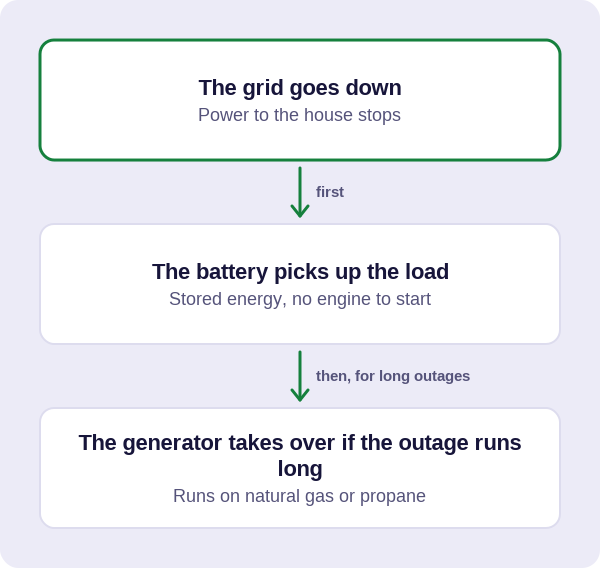
Some homes have both. Generac describes the split. "In this setup, the battery manages everyday energy fluctuations and short outages," it says. Meanwhile "the whole home generator ensures you're protected when outages last longer or demand increases." 1
Its list of reasons includes "Reduced generator runtime (battery handles smaller loads first)". 1 The diagram at the top of this page shows that order.
Before you choose, Generac suggests a few questions. Two of them: "Do outages in my area typically last hours—or days?" and "Do I rely on medical devices, well water, or climate control?" 1
Our guide to home battery backup explains how a wired-in battery works in an outage; click here to read it. For the generator side, see how a Generac whole house generator works and the installed price of a standby unit.
Frequently asked questions
Is a home battery or a generator better for backup?
It depends on how long your outages last and what you need to run. Generac, which sells both, lists a battery for "Short outages (a few hours)" and a standby generator for "Long-duration outages (days or even weeks)". 1
How long does home battery backup last compared with a generator?
Anker SOLIX says "A battery's runtime can be estimated from stored energy and load, while a generator's runtime is primarily determined by fuel supply." A propane unit "is limited by tank capacity and fuel consumption at the actual load." 2
Can I run a generator indoors or in the garage?
No. The EPA says "Never use a portable generator inside homes, garages, crawlspaces, sheds or similar areas." 4
Portable power station vs generator: which is better for an outage?
Anker SOLIX, which sells power stations, says they "are best for essentials (refrigerator, router, lights, fans, and CPAP), not automatic whole-home backup." It adds that "Gas still makes sense for very high loads or very long outages." 3
Can I have a battery and a generator?
Yes. Generac describes a setup where "the battery manages everyday energy fluctuations and short outages, while the whole home generator ensures you're protected when outages last longer or demand increases." 1 Ask your installer how it would be wired in, and leave that work to a licensed electrician.
Sources
- How to Choose Between a Home Generator and Solar Battery for Backup Power, Generac. Checked 20 November 2026.
- Home Standby Generators vs Battery Backup Systems, Anker SOLIX. Checked 20 November 2026.
- Solar Generator vs Gas Generator for Emergency Backup, Anker SOLIX. Checked 20 November 2026.
- Carbon Monoxide's Impact on Indoor Air Quality, US Environmental Protection Agency. Checked 20 November 2026.
- Hurricane eMatrix: Electrical, Occupational Safety and Health Administration. Checked 20 November 2026.