Generator size for whole house: how to work out yours
Disclosure: Some links in this guide are affiliate links. If you buy through them we may earn a commission, at no extra cost to you. We only link to products the guide is about. How we make money.
On this page
- The short answer
- What size whole house generator do you need?
- Start with a list of what has to run
- How many watts for a whole house generator
- Turn the total into a generator size
- Too big and too small both cost you
- Whole house or essential circuits?
- What size portable generator for a whole house?
- Who confirms the size
- FAQ
- Sources
- What to do next
The short answer
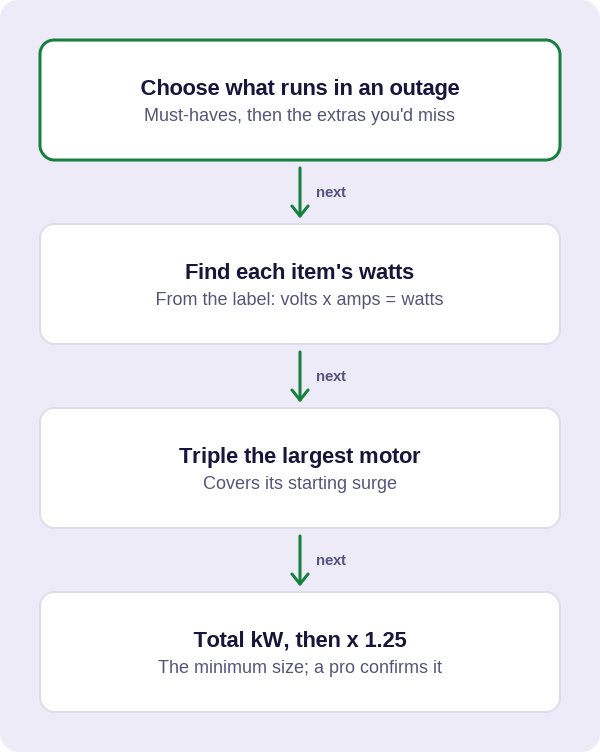
The generator size for a whole house comes from what you want running, not the floor plan. One Generac installer says most homes need a 14 to 22 kW standby generator, and 22 kW runs most 2,000 to 3,000 square foot homes with central air. 1 To estimate yours, add up the watts, triple the largest motor, convert to kilowatts and multiply by 1.25. 3 A dealer or electrician then confirms it.
What size whole house generator do you need?
Most homes land in a fairly narrow band. Wolf River Electric, an authorized Generac dealer in the Midwest, says: "Most homes need a 14 to 22 kW standby generator." 1
Its sizing table splits that by goal:
- Essentials only: 10 to 14 kW. That covers the furnace blower, fridge and freezer, sump pump, lights, internet and a few outlets. 1 - Essentials plus a well pump or central air: 14 to 18 kW. That's the essentials plus a well pump, or central air with load management. 1 - Whole home, about 2,000 square feet: 18 to 22 kW. 1 - Whole home, 2,500 to 3,000 square feet: 22 kW, depending on how many large loads run together. 1 - Large or all-electric homes, shops: 24 to 28 kW. 1
Wolf River says "These ranges follow Generac's own sizing guidance." 1 Keep in mind it sells and installs these units. Square footage is only a rough guide, though. "Two homes with the same floor plan can need very different generators, because what matters is the equipment inside," Wolf River says. 1
A kilowatt (kW) is simply 1,000 watts. Norwall PowerSystems, a generator retailer, puts it this way: "1000 watts equals one kilowatt." 3
Start with a list of what has to run
Sizing starts with a list. "Deciding which electrical circuits and appliances to power in an emergency is the first step to sizing a standby generator for your home," Norwall says. 3
Begin with the must-haves. Norwall names "refrigerators and freezers, central air and furnace, sump pumps, well pumps, and medical equipment" as the most important. 3 If a sump pump is the main worry, see backup power for a sump pump, which compares a battery with a generator. After that, add the extras you'd hate to lose.
Some things hardly matter. "A television doesn't add very much power, nor does charging a cell phone charger or turning on a few lights," Norwall says. 3
Other things matter a lot. Wolf River lists central air or a heat pump as "The biggest surge in most homes" for starting. 1 It warns that "Heat pump backup heat strips use a lot of power" too. 1 An electric water heater, range and dryer are large loads you may choose to leave off or manage, by its account. 1
Size can fool you. "A hair dryer can use 1200 to 1875 watts while an energy-saving LED light bulb might use as little as 6 watts," Norwall notes. 3
How many watts for a whole house generator
Next, put a watt figure beside every item. The nameplate on each appliance has it, though not always in watts. Norwall's conversions are:
- Volts and amps on the label: "volts x amps = watts". 3 - Kilowatts on the label: "kilowatts x 1000 = watts". 3 - Volt-amps (VA) on the label: "volt-amps = watts". 3
Motors are the tricky part. They need a short burst of extra power to start. "Starting power is usually two to three times running power," Wolf River says. 1
Norwall handles that with one step. Pick the motor with the most watts. Then "Multiply that item's Watts x 3, and substitute the result for the original watts listed," Norwall says. 3 That covers what it calls "Starting Watts of any motors". 3
Wolf River gives Generac's rule of thumb a little differently. You "add up the running watts of everything you want on at the same time, then add the single largest starting surge". 1 Both methods aim at the same problem. Don't be surprised if they give different totals.
Turn the total into a generator size
Now add everything up. "Divide the Total Watts by 1000 to find kilowatts," Norwall says. 3
Then leave headroom. "Multiply kilowatts x 1.25 to add a margin of safety and for future power needs," is Norwall's next step. 3 It calls the answer "the minimum Generator Capacity required for your home". 3
Here's a rough worked example, using figures from our two sources. It's an estimate, not a recommendation. Wolf River says a 3-ton central air conditioner "uses about 3.5 to 5 kW running". 1 Norwall says "Refrigerators use 750-950 Watts". 3
- Central air, tripled as the largest motor: 5,000 W × 3 = 15,000 W. 1 3 - One fridge: 950 W. 3 - A hair dryer at the top of Norwall's range: 1,875 W. 3 - Total: 15,000 + 950 + 1,875 = 17,825 W, or 17.825 kW. 3 - With the margin: 17.825 × 1.25 ≈ 22.3 kW minimum (our arithmetic). 3
A real home has more on the list than that. Lights, a furnace blower and a few outlets all add up.
Don't trim it to the bone. Norwall's advice: "Don't choose the bare minimum. Power requirements rarely decrease." 3
Too big and too small both cost you
An undersized unit can't keep up. When it's too small, "the generator overloads when a big motor starts, and things shut off," Wolf River says. 1
A bigger one isn't free, either. "Using too large of a generator is inefficient and wastes fuel," says Norwall. 3 With an oversized unit, Wolf River adds, "you pay more for the unit, the fuel connection and possibly a bigger gas meter, for power you never use". 1
Load management is the middle path. Wolf River says these modules "pause lower-priority loads, like central air or an electric dryer, for a moment when the generator nears its limit, then bring them back". 1 That "lets a mid-size generator handle big loads one at a time," it says. 1
Fuel changes the numbers too. "The same Generac unit is rated slightly higher on propane than on natural gas," Wolf River says. 1
Size drives price. The cost of a whole house generator by size has dated, installed figures in our guide to standby generator prices. How these units start and switch over on their own is covered in our explainer on Generac standby generators.
Whole house or essential circuits?
You can back up everything or a short list. Wolf River says an essential-circuits setup "costs less and suits many homes". 1 Whole-home backup, it says, "means a larger generator and a service-rated transfer switch". 1
Going big can make sense. "Supplying power to the entire home or almost the entire home is certainly an option, and in many cases is the more cost efficient way to go," Norwall says. 3 It adds a caveat. "You still have to determine what you are likely to use during an outage and how much power it requires." 3
A battery is another way to cover the same choice. The difference between whole-home and partial battery backup works the same way, with kilowatt-hours in place of a fuel tank.
What size portable generator for a whole house?
A portable generator usually isn't sized for a whole house. Wolf River's comparison puts a larger portable generator at 7 to 10 kW. It lists what one runs as "Several chosen circuits, once it is hooked to the house". 2
That hookup is not a cord into a wall socket. OSHA's rule: "Never attach a generator directly to the electrical system of a structure unless a qualified electrician has installed a transfer switch for the generator." 4 Poudre Valley REA, an electric co-op, warns: "Never plug a portable generator directly into a wall outlet or electrical system." 5 Our page on transfer switches explains what the switch does, and the interlock kit comparison covers the other common option.
Where it runs matters as much as its size. Generators give off carbon monoxide (CO). OSHA says: "Never use a generator indoors or in enclosed spaces such as garages and basements; opening windows and doors may not prevent CO from building up in those spaces." 4
Outdoors has a rule too. "Do not use a generator outdoors near doors, windows, and vents that could allow CO to enter," OSHA says. 4
Who confirms the size
Your own sum is a first draft. Norwall says its guides "are intended for estimating purposes only". 3 Its advice: "Always have an authorized dealer or qualified electrician analyze your specific requirements before making a purchase decision." 3
Online calculators "can't see your panel or nameplates," Wolf River says. 1 On its own site visits, "A licensed electrician reads your panel and the nameplates on large equipment." 1 It also checks the gas meter or propane tank. 1
A standby generator connects through a transfer switch. That's a licensed electrician's job, with a permit where your area needs one. "Transfer switches should always be installed by a professional," says Poudre Valley REA. 5 This page gives no wiring steps.
Questions worth asking the installer:
- What did you count in the load calculation? - Which motor sets the starting surge? - Would load management let me buy a smaller unit? - Is my gas meter or propane tank big enough? - Is it a whole-home or essential-circuits transfer switch?
Frequently asked questions
What size whole house generator do I need?
Wolf River Electric, a Generac dealer, says "Most homes need a 14 to 22 kW standby generator." It puts whole-home backup for about 2,000 square feet at 18 to 22 kW. A dealer or electrician's load calculation sets your actual size. 1 3
How many watts generator for a whole house?
Add the watts of everything you'll run, triple the largest motor, divide by 1,000 and multiply by 1.25. Norwall calls the result "the minimum Generator Capacity required for your home." 3
Will a 22 kW generator run a whole house?
Wolf River says: "For most homes up to about 3,000 square feet, yes, especially with load management. Homes with electric heat or several air conditioners may need more." 1
What size portable generator for a whole house?
Wolf River puts a larger portable at 7 to 10 kW, running "Several chosen circuits, once it is hooked to the house" rather than the whole home. OSHA says never to attach one to a home's wiring "unless a qualified electrician has installed a transfer switch for the generator." 2 4
Sources
- What size generator do I need?, Wolf River Electric. Checked 16 November 2026.
- Whole house generator cost, Wolf River Electric. Checked 16 November 2026.
- Home Generator Sizing Guide, Norwall PowerSystems. Checked 16 November 2026.
- Electrical: Hurricane eMatrix, U.S. Occupational Safety and Health Administration. Checked 16 November 2026.
- Beware of Backfeed, Poudre Valley REA. Checked 16 November 2026.