Generac generator for a whole house: how they work
Disclosure: Some links in this guide are affiliate links. If you buy through them we may earn a commission, at no extra cost to you. We only link to products the guide is about. How we make money.
On this page
- The short answer
- What a Generac whole house generator is
- Picking a size, including a 22kW Generac
- What fuel it uses
- How much a Generac whole house generator costs
- How to install a Generac whole house generator
- Safety: outdoors only, never backfed
- How long a Generac whole house generator lasts
- Where a battery fits in
- FAQ
- Sources
- What to do next
The short answer
A Generac generator for a whole house is a home standby generator. Generac says it "automatically supplies electricity to your home during a power outage." 1 One installer lists a Generac 22 kW at about US$16,600 installed, as of October 2026. 2 A licensed electrician fits it.
What a Generac whole house generator is
Generac makes home standby generators. People often call them whole house generators. The name is a loose one. Generac says a standby unit "can power selected circuits or an entire home." 1
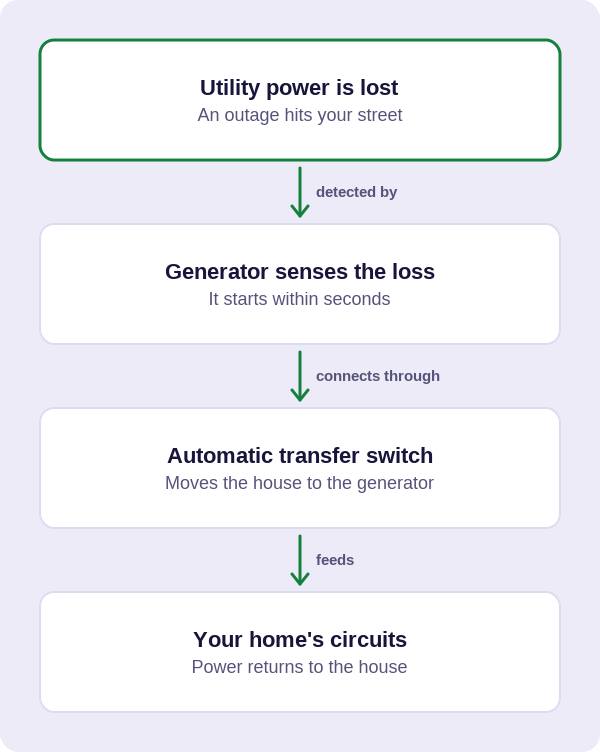
The unit sits outside, on a pad. It's wired into your home through a switch. Generac says it "is connected to your home's electrical system through an automatic transfer switch." 1
Then it works on its own. Generac says "the generator detects when utility power is lost and turns on within seconds to restore power to your home." 1 When the grid comes back, "the generator turns off." 1
That's the main difference from a portable generator. Generac says portable generators "require manual setup, refueling, and connection to appliances or transfer equipment." 1
If you want to know what the switch does, this guide to transfer switches covers it.
Picking a size, including a 22kW Generac
Size is the first question. Generac gives a rough guide. "Smaller homes may require a 10–18kW home standby generator." 1 Larger homes "may need 22kW-28kW." 1
That's a range, not a rule. Generac says the answer turns on square footage, electrical usage and what you want to run in an outage. 1
A dealer can help with a "load assessment." 1 That's a count of the appliances and systems the unit must carry.
Bigger costs more. Wolf River Electric, an installer, puts the step from a 14 kW unit to a 26 kW unit at "about $4,200." 2
All-electric homes need a closer look. For an all-electric home, Generac says "a larger sized generator might be needed." 1 It suggests "working with an electrical professional when determining generator size." 1
What fuel it uses
Generac says its standby generators run "on natural gas or liquid propane (LP), depending on what fuel source is available." 1
Generac says natural gas generators "connect directly to an existing gas utility line." 1 Propane-powered standby generators "use an on-site fuel tank." 1
Gas lines matter for cost. Wolf River says a natural gas unit needs a big enough meter and line. 2 A long run of pipe or a meter upgrade "adds cost." 2
How much a Generac whole house generator costs
The Generac page we read doesn't list an installed price. So these figures come from an installer, and they're one company's numbers.
As of October 2026, Wolf River Electric lists a Generac 14 kW at about $13,500 installed and the 22 kW at about $16,600. 2 All amounts are in US dollars.
The 22 kW price covers the unit, the pad, the transfer switch, the permit and the work. 2 Sales tax and the gas or propane hookup are extra. 2
So the price you see isn't the whole bill. Ask each installer what's in the quote. Our cost of a whole house generator page lists the questions to ask.
How to install a Generac whole house generator
This isn't a do-it-yourself job.
Safe Electricity, a utility safety group, puts it plainly. "A licensed professional should install a permanent, standby electric generator." 3
It adds that a qualified electrician should be consulted to ensure grounding, overload protection and local codes are met. 3
We give no wiring steps here. Installer quotes can cover the permit too, and some towns ask for zoning or setback approvals as well. 2
Before you sign, get answers to these:
- Which size is quoted, and what load count backs it up? - Does the price include the automatic transfer switch? - Who applies for the permit? - Who pays to bring in the gas or propane line?
Safety: outdoors only, never backfed
A fuel generator gives off carbon monoxide. Safe Electricity's tips for portable generators say to use one in a "dry, open, well-ventilated" area "away from the home or garage." 3 That advice is written for portable units, not standby ones. Follow the clearances in Generac's manual for your model.
Never plug a generator into a wall outlet to feed the house. That's backfeed, and it can "seriously injure anyone near lines." 3
The safe route is a transfer switch. Safe Electricity's advice: "Have a qualified electrician install a transfer switch." 3
How long a Generac whole house generator lasts
Generac says "a well-maintained home standby generator can last 20 years or more, depending on usage, operating conditions, and routine maintenance." 1 That's the maker's claim about a well-maintained unit.
On runtime, Generac says a unit "can run for as long as fuel is available and the unit is properly maintained." 1 It adds: "For every 24 hours of use, the oil levels should be checked and oil added if necessary." 1 Our page on how long a whole house generator can run works through a propane example.
Where a battery fits in
A generator isn't the only way to keep the lights on. Wolf River says a home battery is quiet and needs no fuel, but covers "hours of backup rather than days" unless solar recharges it. 2 For one job, keeping a basement dry, our page on a sump pump battery backup vs a generator sets the two side by side.
Our guide to what a home battery does in an outage explains how those work. If a few essentials are enough, see power stations for a few essentials. For a battery that powers more of the house, read whole home battery backup versus partial.
Frequently asked questions
How much does a Generac whole house generator cost?
One installer, Wolf River Electric, says "about $13,500 to $17,700 installed, as of October 2026." 2 Sales tax and the gas or propane hookup are extra. 2 Get written quotes.
What size Generac generator do I need for my whole house?
Generac says "smaller homes may require a 10–18kW home standby generator, while larger homes with multiple air conditioning units or high electrical demand may need 22kW-28kW." 1 A dealer can run a load assessment. 1
How do I install a Generac whole house generator?
A licensed electrician does it. Safe Electricity says "a licensed professional should install a permanent, standby electric generator." 3 This page gives no wiring steps.
What fuel does a Generac whole house generator use?
Generac says it runs "on natural gas or liquid propane (LP), depending on what fuel source is available." 1
Can a Generac whole house generator run in a garage?
Safe Electricity's tips for portable generators say to place one "in a dry, open, well-ventilated area away from the home or garage." 3 A standby unit is a different case, so follow Generac's manual for your model and ask a licensed electrician or installer.
Sources
- Home Standby Generators, Generac. Checked 8 November 2026.
- Whole House Generator Cost in 2026: Installed Prices, Wolf River Electric. Checked 8 November 2026.
- Use Caution When Using Back-Up Generators, Safe Electricity. Checked 8 November 2026.