Whole house generator installation: what's involved
Disclosure: Some links in this guide are affiliate links. If you buy through them we may earn a commission, at no extra cost to you. We only link to products the guide is about. How we make money.
On this page
- The short answer
- The steps of a whole house generator installation
- Step 1: the dealer visit
- Step 2: permits and approvals
- Step 3: where the generator goes
- Step 4: the pad, fuel line and transfer switch
- Who does the work: finding a whole house generator installer
- How long it takes, and what it costs with installation
- FAQ
- Sources
- What to do next
The short answer
Whole house generator installation runs from a dealer visit to a pad, a fuel line, a transfer switch and a test. Generac says the team will "prepare the site, often with a concrete slab or pea gravel". 1 Then they "connect the fuel line, and install a transfer switch next to your main breaker box". 1 The fitting "usually takes hours," but preparing for it "takes multiple weeks". 1
The steps of a whole house generator installation
A home standby generator isn't a box you plug in. It's a permanent machine, wired into your panel and piped to your gas or propane. So the job has several stages, and different trades handle different parts.
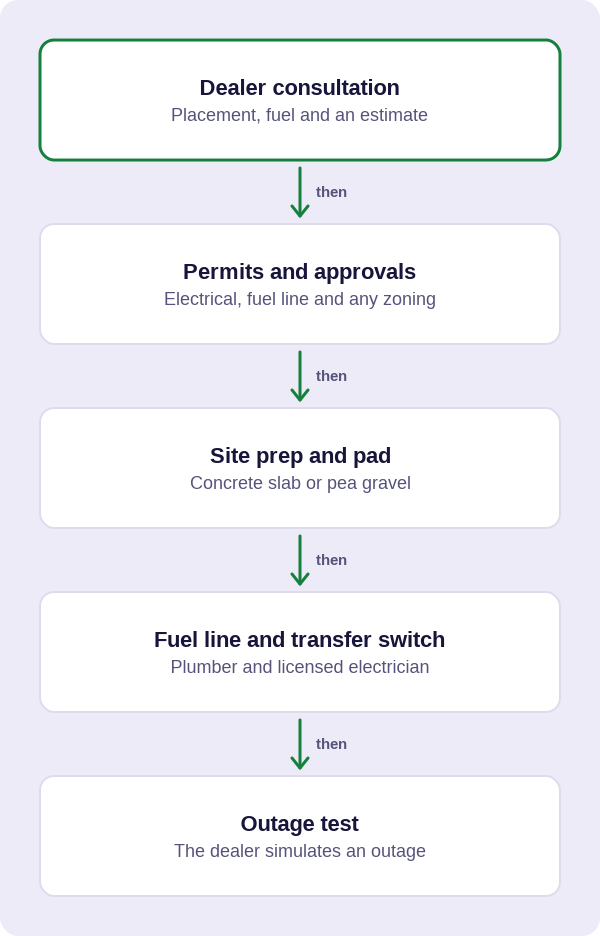
Generac lays out the order on its installation page. First a site is chosen. Then "your dealer's local team will prepare the site, often with a concrete slab or pea gravel". 1 They then "connect the fuel line, and install a transfer switch next to your main breaker box". 1
The last step is a test. Generac says: "Before installation is complete, your dealer will make sure your home standby solution runs properly by simulating an outage". 1
The diagram above shows that order. We've drawn permits near the start. Generac lists "obtaining a permit" among the things that affect how long the job takes. 1
Step 1: the dealer visit
Generac's process starts with a visit from a dealer. It says one or more of its dealers will "schedule a free no-obligation at-home consultation". 1 At that meeting you can expect to discuss:
- "Generator placement" - "Installation site requirements" - "Any necessary system requirements" - "Fuel source and connection" - "Property restrictions (including HOA or community regulations)"
Those five come from Generac's own list. 1 The dealer also gives you "custom estimates for total solution cost". 1
It helps to have a rough size in mind before the visit. Our page on working out a standby generator's kW shows the arithmetic, so you can check the dealer's number. If you haven't settled on a fuel or a brand yet, how Generac's home standby range works is a gentler place to start.
Step 2: permits and approvals
Permits vary by town, county and state. This Old House says: "Many local municipalities require permits for generator installation to ensure safety and compliance with building codes". 2 It lists common ones:
- "Electrical permits for wiring" - "Plumbing permits for fuel line connections" - "Zoning permits that stipulate where you can install the generator"
Skipping them has a cost. This Old House warns that "failing to obtain necessary permits can lead to fines and might invalidate your homeowner's insurance". 2
Ask each installer who pulls the permits and whether they're in the quote. Your local building department has the final word on what's needed.
Step 3: where the generator goes
Placement is set by codes and by the maker's manual, not by taste. Briggs & Stratton makes standby generators. It says placement is "subject to regulations and requirements from organizations like the National Fire Protection Association (NFPA), power supply companies, local government building code authorities and the manufacturer". 3
The rule most people hear about is distance from openings. Briggs & Stratton says: "Standards require all parts of a standby generator to be placed at least five feet away from windows, doors and other wall openings". 3 In a separate passage, Briggs & Stratton also notes that "carbon monoxide emissions can seep in through the smallest cracks". 3 For its own clearance figures from walls, This Old House says "this eliminates a potential fire hazard and ensures adequate airflow around the unit". 2
Some units can sit closer to a wall. Briggs & Stratton says several of its fire-tested generators "can be placed as close as 18 inches to a structure". 3 It adds: "This is also the case if the walls of the building have a one-hour fire rating". 3 Your unit's own manual and your local code decide the exact figures.
Cost comes into it too. Generac says the dealer looks for a site like this: "a stable, well-drained area with enough space to accomodate generator maintenance". 1 It adds: "The closer the site is to a natural gas line and the electric meter, the more you will save on installation costs". 1
Step 4: the pad, fuel line and transfer switch
This is the main day of work. This Old House lists the jobs:
- "Install a pre-cast concrete pad supported by a compacted gravel bed". - "Position the generator on the concrete pad". - "Have a licensed plumber connect the natural gas or propane line". - "Install a transfer switch beside the electrical meter".
Those four lines are its words. 2 Generac's page mentions pea gravel as another base. 1 Your installer's plan may differ.
The transfer switch is the safety piece. Generac calls it "the piece of your backup power system that will automatically kick your generator into action after a loss of utility power". 1 It also keeps your house cut off from the grid while the generator runs. Safe Electricity, a utility safety program, says a standby generator "must have an approved transfer safety switch to avoid feeding electricity back into the electrical system outdoors". 4 That's called backfeed, which Safe Electricity calls "dangerous for line workers". 4
For more on the switches themselves, read how a Generac automatic transfer switch fits in.
Who does the work: finding a whole house generator installer
Your whole house generator installer may need more than one trade on the job. This Old House lists who to call:
- "Electricians for wiring and transfer switch installation" - "Plumbers for fuel line connections" - "HVAC technicians for any necessary ventilation work"
Those come straight from its safety section. 2 On the transfer switch, it quotes its own magazine: "the connections are easy, but there is no room for error, so this is a job only for licensed electricians". 2
So this isn't DIY. We don't give wiring steps on this site. Who should fit the transfer switch? Safe Electricity names "a qualified electrician". 4
How long it takes, and what it costs with installation
The work on the day is fast. The wait before it isn't. Generac says installation "usually takes hours, but the process of preparing for it takes multiple weeks". 1 It puts the delay down to "dealer availability, site preparation, gas line preparation, obtaining a permit, and more". 1
On price, Generac gives one range. It says that "on average, installation costs of a home standby generator range from $8,000-16,000 including the generator itself". 1 Those are US dollars, read on Generac's page on November 20, 2026. Generac adds that "pricing can vary based on several factors, including the complexity of the installation process and your location". 1
So that range is a guide, not a quote. Our page on what drives a standby generator's price goes through one installer's dated figures line by line.
If the quotes feel high, a home battery is the other route. Comparing a battery with a gas generator sets the two side by side.
Frequently asked questions
How much is a whole house generator with installation?
Generac says "on average, installation costs of a home standby generator range from $8,000-16,000 including the generator itself." 1 That's in US dollars, checked on November 20, 2026. Your quote depends on your site and location.
What is the installation cost for a whole house generator?
Generac's $8,000 to $16,000 range covers the generator, equipment, materials and installation together. Its page says total costs are "inclusive of the Generac Generator, System Equipment & Materials, and Installation." 1
How long does a whole house generator installation take?
Generac says it "usually takes hours, but the process of preparing for it takes multiple weeks." 1 Permits and gas line work are part of that wait.
Can I install a whole house generator myself?
No. The wiring and transfer switch are for a licensed electrician, and the gas line for a licensed plumber. This Old House calls the transfer switch "a job only for licensed electricians." 2
How far from the house does a standby generator have to be?
There isn't one figure. It depends on the wall and the unit. This Old House says "typically, a unit should be installed at least 5 feet from combustible materials, such as wood siding, and at least 3 feet from noncombustibles, like brick". 2 Briggs & Stratton says standards require all parts of a standby generator to be "at least five feet away from windows, doors and other wall openings". 3 It also says some of its fire-tested units "can be placed as close as 18 inches to a structure". 3 Your generator's manual and your local code set the exact clearances.
Sources
- Backup Generator Installation, Generac. Checked 20 November 2026.
- How To Install an Automatic Standby Generator, This Old House. Checked 20 November 2026.
- Determining the Best Location for Your Home Generator, Briggs & Stratton Energy Solutions. Checked 20 November 2026.
- Use Caution When Using Back-Up Generators, Safe Electricity. Checked 20 November 2026.