Tesla Powerwall tax credit: does it still qualify?
Disclosure: Some links in this guide are affiliate links. If you buy through them we may earn a commission, at no extra cost to you. We only link to products the guide is about. How we make money.
On this page
The short answer
For a new install, no. The Tesla Powerwall tax credit people ask about is the IRS Residential Clean Energy Credit. The IRS now says it "is not available for any property placed in service after December 31, 2025" 1. A Powerwall installed in 2023 to 2025 was in a different spot: the credit covered "Battery storage technology (beginning in 2023)" with "a capacity of at least 3 kilowatt hours" 1. We checked on 27 November 2026. This isn't tax advice, so ask a tax adviser about your own return.
Does a Tesla Powerwall qualify for a tax credit in 2026?
Not the federal one, if it's installed now. The credit in question is the IRS's Residential Clean Energy Credit, also called section 25D. Its cut-off was the last day of 2025, and the IRS page for it says so plainly 1. That page was last reviewed or updated on 23 November 2026 1.
Why so soon? A 2025 law, Public Law 119-21, moved the end date up. In the IRS's FAQ on that law, the 25D row of its table gives the date as December 31, 2025 2.
The IRS instructions for Form 5695, the form used to claim the credit, say the same thing. "You can’t claim residential clean energy credits for expenditures made after December 31, 2025," they say under What's New 3.
So for a Powerwall installed now, the IRS says this credit isn't available. Our page on state and utility money for a Powerwall covers what's left, such as California's SGIP and Vermont's Green Mountain Power programs.
Why a Powerwall counted before 2026
Home batteries were added to the credit in 2023. The IRS list of qualified expenses includes "Battery storage technology (beginning in 2023)" 1. Until the cut-off, the IRS put the credit at 30% of the costs of new, qualified property. That applied to property installed from 2022 through December 31, 2025 1.
The IRS page sets one standard for batteries. "Battery storage technology must have a capacity of at least 3 kilowatt hours," says the IRS 1. A kilowatt-hour (kWh) is a measure of stored energy.
Tesla's own figures sit well above that line. Its Powerwall 3 specification page lists "Nominal Battery Energy 13.5 kWh" 4. For Powerwall 2, Tesla lists "Usable Energy" of 13.5 kWh and "Total Energy" of 14 kWh 5. That's more than four times the 3 kWh floor. It's simple arithmetic, not a ruling, and the size test was only one of the conditions. If you're not sure which model you have, our page on Powerwall capacity by model lists Tesla's figures for each one.
Form 5695 asks the size question directly. On lines 5a and 5b, "If the qualified battery storage technology has a capacity of 3 kilowatt hours or greater, then check the “Yes” box," the instructions say 3. "If you check the “No” box, you can't include any battery storage technology costs on line 5b." 3
Paid in 2025, installed in 2026
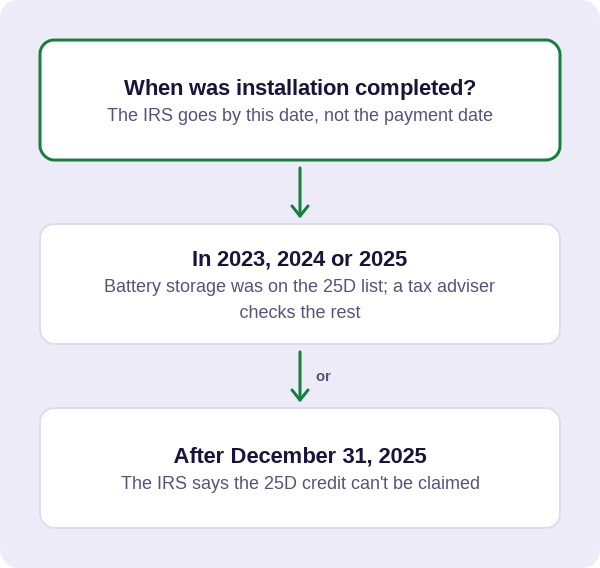
Here is a common timing question. You signed and paid for a Powerwall in 2025, but the installer didn't finish until 2026 2.
The IRS took this exact question in its FAQ, FS-2025-05. Question 7 covers a taxpayer who "pays for the property on or before December 31, 2025" when it's "installed after December 31, 2025." The reply opens with one word: "No." 2
Why? The tax law dates the cost by the install, not the payment. The Form 5695 instructions say "costs are treated as being paid when the original installation of the item is completed" 3. Finishing after the cut-off, the FAQ adds, "will prevent the taxpayer from claiming the section 25D credit" 2.
Paying early doesn't change that, going by the IRS answer. The install date does. The IRS also notes its FAQs "may be updated or modified upon further review," so look again before you file 2.
If your Powerwall was installed in 2025 or earlier
Your dates may still fit the old rules. Whether you can claim anything depends on your own facts, and we can't tell you that. A few points on the IRS page are easy to miss 1.
- A second home. "You may be able to claim a credit for certain improvements made to a second home located in the United States that you live in part-time and don't rent to others." 1 - A home office. "If you use a property solely for business purposes, you can't claim the credit." For homes used partly for business, the IRS page says "Business use up to 20%: full credit" 1.
There are more conditions than these. Our explainer on the end of the federal battery credit goes through the rest, including how state rebates are treated. A tax adviser can tell you how any of it applies to your return.
Before you sign a Powerwall quote now
An older ad or brochure may still promise a 30% federal credit on a Powerwall. If a quote leans on one, ask the seller to name it and show you where it's written. Then hold it up against the IRS's own page, which ties the credit to installs through December 31, 2025 1.
Questions worth asking an installer:
- Does this price assume any tax credit or rebate? - If so, which program is it, and where's its official page? - Who applies for it, and what if the money runs out?
Without the credit, the case for a Powerwall rests on backup. Our guide to how many hours a Powerwall can keep the lights on works through outage runtimes from Tesla's figures. And whatever you buy, the install is a job for a licensed electrician, with a permit if your area asks for one.
Frequently asked questions
Does the Tesla Powerwall qualify for a tax credit if it's installed in 2026?
Not the federal Residential Clean Energy Credit. The IRS's Form 5695 instructions say "You can’t claim residential clean energy credits for expenditures made after December 31, 2025" 3. A state or utility program may still offer money, so check your utility and state energy office. Ask a tax adviser about your own return.
Is there a tax credit for a Tesla Powerwall I paid for in 2025?
The IRS goes by when installation was completed, not when you paid. Its FAQ says a finish date after December 31, 2025 "will prevent the taxpayer from claiming the section 25D credit" 2. A tax adviser can look at your dates.
Was the Powerwall big enough for the battery credit?
On size alone, Tesla's figure clears the IRS floor of 3 kWh by a wide margin: Powerwall 3 is listed at 13.5 kWh 1 4. Size was only one of the conditions, though.
Where does the battery go on Form 5695?
Lines 5a and 5b. Line 5a asks whether the battery is 3 kWh or more. "If you check the “No” box, you can't include any battery storage technology costs on line 5b," the instructions say 3. This only applies to installs the credit still covers.
Sources
- Residential Clean Energy Credit, Internal Revenue Service. Checked 27 November 2026.
- FAQs for modification of sections 25C, 25D, 25E, 30C, 30D, 45L, 45W, and 179D under Public Law 119-21 (FS-2025-05), Internal Revenue Service. Checked 27 November 2026.
- Instructions for Form 5695 (2025), Internal Revenue Service. Checked 27 November 2026.
- Powerwall 3 Specifications (Powerwall 3 Installation Manual with Backup Switch), Tesla. Checked 27 November 2026.
- Powerwall Specifications (Powerwall 2 with Backup Gateway 2 Installation Manual), Tesla. Checked 27 November 2026.